Our objective here: To create a system that helps break out of repetitive cycles. The focus is on identifying the "bottleneck" -- the specific factor that's limiting your growth and development.
Introduction
At any given moment, we have an infinite number of paths and opportunities that can take us where we want to go. Often, the limitations and excuses we create come from within. For example: self-pity, overprotectiveness towards ourselves, or the desire to remain in a comfort zone.
On the flip side, sometimes we overlook our limits and push ourselves too far, to the point of injury. For example, ligaments adapt to loads much faster than muscles, and intense strength training can lead to harm.
I want to start with mindset because it's the foundation for future growth and development. The internet is full of exercises on finger strength, endurance, and technique, but in reality it's hard to combine all of this into a clear, unified system. Without the bigger picture, it's difficult to understand how these pieces fit together and how to apply them to your own life, physical condition, and progress.
Your mind is like a muscle -- it needs training. When you start climbing, certain skills are required, but as you progress, you'll need to develop entirely new ones.
The Progression Path
5th to 6th grade
Most people already have the necessary physical foundation. At this stage, you need to refine your technique and overcome basic fears of height. This requires modest effort, and it's crucial to absorb as much information as possible.
6th to 7th grade
More advanced technical skills demand greater physical preparation. This means dedicating time not only to climbing but also to specific physical training. More training requires more discipline, which may mean adjusting your lifestyle and weekly routine.
7th to 8th grade
This involves structured work on multiple skills, such as technique, physical fitness, mobility, and coordination. Increased training means you'll also need to focus on proper recovery. The simplest step is ensuring quality sleep. If you stay up late and don't sleep enough, you won't recover, and that could mean a wasted week of training.
8th to 9th grade and beyond
This is the stage of mastery refinement, which involves a lot of routine work -- discipline, mindfulness, planning, and frequent training.
As you progress from one grade to another, there won't be just one solution to your problems. Each new level will require finding new keys because they'll differ from the ones you used previously.
The ATPEM Model
Before we delve into technical and physiological aspects, I want to outline the levels we need to consider at any given moment.
The ATPEM model is a pyramid with five levels, from top (most visible) to bottom (deepest foundation):
Level 1 (top)
Actions
Level 2
Tools
Level 3
Planning
Level 4
Environment
Level 5 (bottom)
Mindset
- Actions (Level 1, top) -- The specific things you do to achieve your goals
- Tools (Level 2) -- Equipment, software, training aids, and information that support your journey
- Planning (Level 3) -- The path you're following -- your training plan
- Environment (Level 4) -- The people who surround and support you
- Mindset (Level 5, bottom/foundation) -- Personal principles, beliefs, worldview, and habits -- the foundation of everything
The Key Insight:
The quality of our actions is influenced by our tools, planning, environment, and mindset. When progress stalls, the solution often lies in examining a deeper level of the system.
Level 1: Actions
Actions sound simple -- just do it. But at the same time, it's difficult. This is a crucial step, and without it, there will be no results. The quality of your actions determines the results you achieve.
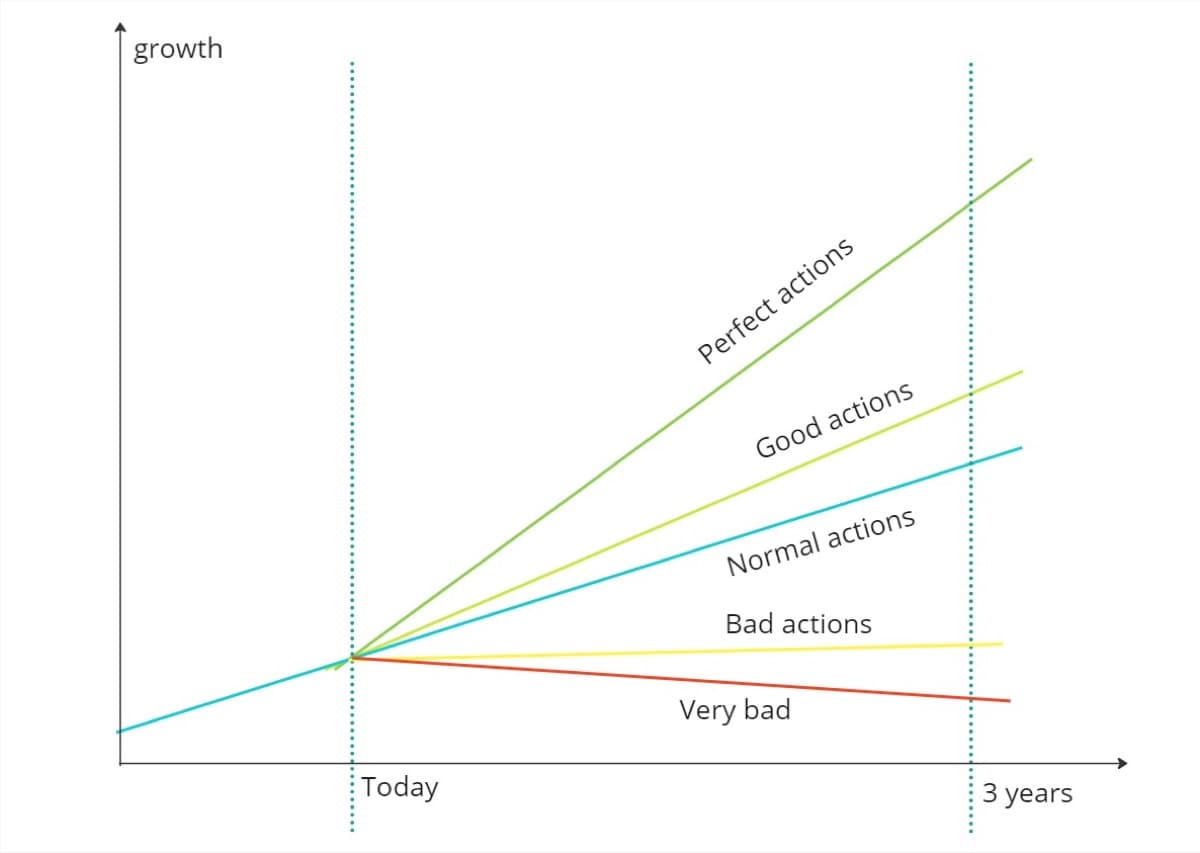
Evaluating Your Results
Very Poor: I train, but I keep getting injured, and each time I recover, I get injured again. This repeated pattern shows a loop -- meaning I'm stuck in the same cycle of actions.
Poor: I train, but there's no progress. Odd, isn't it? You invest time, but don't move forward. What's wrong with the actions you're taking if you're standing still?
Normal: You train, grow gradually, make mistakes, suffer minor injuries while exploring your limits, but you continue to grow. Time is still being spent inefficiently, though.
Good: You train and see consistent progress. You're using your time efficiently to improve.
Excellent: Every training session is well-planned and maximally efficient. There's an ideal balance between results and time invested.
Reflection Questions:
- Write down all climbing-related actions that have led to specific results
- Draw parallels in life -- what areas have you been stuck in a loop, and what areas have shown growth?
Level 2: Tools
If your results are repetitive or unsatisfactory, it means you need to change your actions. The question is: how do you change actions to get a different outcome? To do this, you need to go one level deeper and analyze what's happening there.
The level of tools refers to the things that help us achieve results, track progress, and measure improvements. This ranges from clothing and footwear to climbing walls, training devices, and software.
Common Limitations
- Small gym or limited holds
- Routes not reset often enough
- Lack of training equipment
- Poor quality gear
Key Questions:
- What is the limiting factor in your progress, and what tool could help you overcome it?
- Can the absence of this tool be substituted for something else that would achieve a similar outcome?
Level 3: Planning
"If I had an hour to solve a problem, and my life depended on the solution, I would spend the first 55 minutes formulating the right question; because if you ask the right question, the problem can be solved in less than five minutes." -- Einstein
You can buy the best gear, watch tons of YouTube videos, read smart books on finger strength, go to the most advanced climbing gym, but without a plan, all you have is a collection of chaotic actions leading to unpredictable results.
Athletes train in cycles. Olympic athletes aim to peak at the right moment to show their best results. Planning helps us be in the right shape at the right time. When you're going to a dinner, you think about what you'll wear; when speaking in public, you plan your speech. In climbing, planning helps us get predictable results.
Usually, a lack of a plan is linked to a lack of goals. When you have a goal, your brain searches for ways to achieve it. The question is whether you have the competency to design a quality path toward the goal.
Level 4: Environment
Your environment is a powerful external factor that supports and motivates you. People are social beings, reliant on support and approval. For many, being outside the group can feel like isolation.
Reflection Question:
Do you have a community or people who are aligned with you, supporting and helping you?
Level 5: Mindset
Mindset is the foundation of everything. Our beliefs, fears, principles, and perceptions shape not only our actions but also the results we achieve in any area of life. Often, mindset is the main limiting factor.
5 Common Mindset Barriers
1. Attachment to the Comfort Zone
Many people don't grow because they consciously or unconsciously fear stepping out of their comfort zone. It's easier for them to continue doing what they already know than to face new challenges.
Example: At work, someone consistently performs their duties but is afraid to take on new projects or responsibilities. They stay in the same position for years, even though they could have moved up the career ladder.
2. Fear of Failure and Criticism
This fear often arises in people who strive for perfectionism. They believe that if they can't do something perfectly, it's better not to do it at all.
Example: A young entrepreneur is afraid to launch a new product because they believe it isn't perfect. They delay the launch over small details, fearing negative feedback.
3. Negative Beliefs and Internal Limitations
Many people don't realize that their internal beliefs are the obstacles blocking their success. These may include thoughts like, "I'm not good enough," "This is too hard for me."
Example: Someone wants to start working out but holds the belief that "everyone is better than me" or "I'm not strong enough to climb." This internal limitation prevents them from even trying.
4. Fear of Big Goals and Responsibility
Sometimes people avoid growth because they understand that big goals require big commitments. The more goals you achieve, the higher the level of responsibility.
Example: An employee is offered a promotion with a higher salary, but they decline because they fear the responsibility of managing new employees and complex projects.
5. Fear of Change and the Unknown
People often avoid change because the unknown is frightening. Even if their current situation isn't ideal, it's familiar and predictable.
Example: Someone knows that their job no longer brings satisfaction or opportunities for growth, but they don't change it because of fear of a new workplace.
Conclusion
Each level -- Actions, Tools, Planning, Environment, and Mindset -- matters in its own way, and each requires its own depth. When everything is working, it's enough to simply act and follow the plan. But when chaos appears or something feels off, it's important to pause and go one level deeper, closer to the root of the problem.
Sometimes the issue lies in the tools, sometimes in the plan or the environment, and sometimes in the very foundation -- your mindset. By descending to the real source and examining the system more deeply, you can restore balance, bring clarity, and continue progressing with more confidence and stability.
Don't want to sort through all these details yourself?
Get Your Personalized Training Plan