The most important thing I realized long ago is this: muscles adapt to load in a few weeks. Tendons take months. But the mind... there's no single timeline for that. Sometimes it changes in a moment -- one fall, one slip, one conversation with yourself -- and you're already a different person. And sometimes it takes years.
That's the part many forget about. The mind needs training too -- no less than strength. It's the same kind of work, the same kind of practice: repeatedly stepping into discomfort, learning to trust yourself, learning not to panic, learning not to run from fear but to analyze it and manage it.
When I first started climbing, fear was my constant companion, as it is for most beginners. But over time, through training and experience, I realized that fear isn't an enemy -- if you learn to control it. I want to share my experience and explain how fear affects performance, drawing both from personal stories and scientific research.
1. What Is Fear in Climbing?
Fear in climbing can take many forms: fear of height, fear of falling, or fear of looking weak if you're used to being the "strong one." All of these fears are natural. They're ways the brain protects us from uncertainty or danger.
Since ancient times, our brains have been wired for survival. When we face a situation it perceives as threatening -- whether it's exposure or the risk of a fall -- the sympathetic nervous system activates the "fight or flight" response.
However, when fear becomes excessive, it turns against us -- paralyzing action or making us avoid challenges. It halts progress and leads to stagnation.
Personal Story:
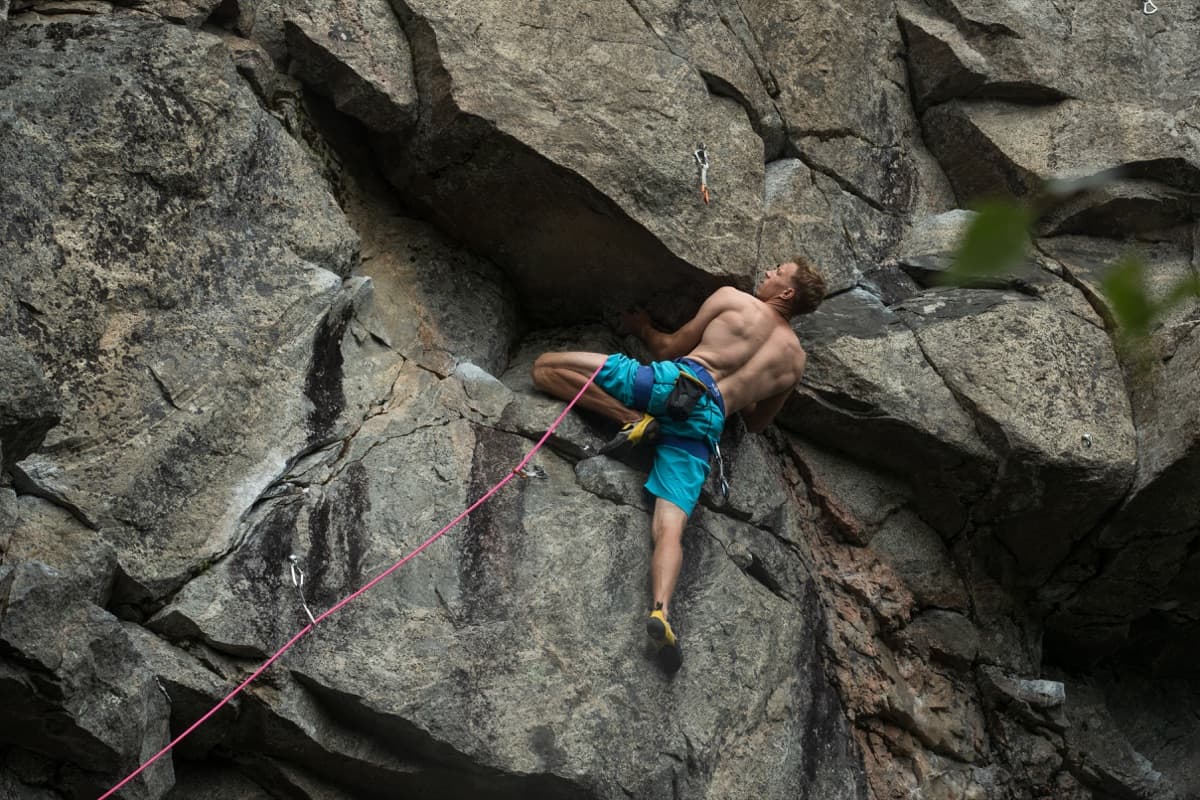
When I first got on a 7b route, there was a crux move where I felt I might fall. I simply couldn't make myself commit. The fear of falling became a wall. There was a poor foothold, and I had to trust it -- but I couldn't. I downclimbed, sat under the route, analyzed, and tried again. I repeated this several times until I convinced my mind that the fall itself wasn't dangerous -- that in that section, nothing serious could happen, and the worst outcome would be a light scrape. That fear made me stronger. It forced me to confront my weak points and work on them -- and in the end, I sent the route. Fear helped me grow, but only after I learned to manage it.
2. Fear and Its Relationship to Performance
There's an important principle worth mentioning -- the Yerkes-Dodson law. It describes how the level of arousal (or stress) influences performance.
Yerkes–Dodson Law — Stress vs. Performance
The Relationship between Stress and Performance
Low Stress
Bored, unfocused
Optimum
Peak performance
Overload
Fatigued, anxious
Breakdown
Panic, burnout
Too little stress = boredom. Too much stress = burnout. The key is balance.
Too Low: When arousal is too low -- for instance, when we're calm and relaxed -- motivation drops and we underperform. We're too comfortable to push our limits.
Optimal: Optimal performance occurs at a moderate level of arousal -- not too low, not too high. At that point, energy and focus merge, allowing us to perform at our peak.
Too High: When stress or fear is too high, panic sets in. It blocks clear thinking and coordination. In that state, we make more mistakes, and even small errors feel catastrophic.
3. The Neuroscience of Fear and Control
Fear activates ancient parts of the brain, such as the amygdala, responsible for detecting threats. But fear can be useful if we learn to regulate it.
When we face fear-inducing situations, the brain engages learning processes. Regions responsible for memory and attention -- such as the hippocampus -- become active. This helps us remember dangerous situations and adapt in the future. It's a protective mechanism, but one that can be harnessed for growth.
Example: If you once feared a difficult route, that fear can become motivation to improve your technique or preparation. By realizing that fear corresponds to a real risk (for example, poor foot placement), you can channel that energy into developing skills that reduce the danger.
4. Insecurity and Fear
Lack of confidence often triggers fear. When you doubt your ability to complete a route, the brain switches into "protection mode," activating fear. I've noticed it many times: the moment doubt creeps in, movement becomes stiff and hesitant.
But the key is understanding that insecurity isn't failure -- it's a growth point. You overcome it through gradual exposure and consistent practice.
When you understand fear and learn to manage it, it stops being an obstacle -- it becomes an ally. It directs your attention to what needs improvement. For example, if you fear falling, that's a signal to work on your footwork or grip control. Fear motivates progress.
Fear is a natural and essential part of climbing. It can become your ally if you learn to understand and regulate it. By managing fear, you'll improve focus, technique, and overall performance as a climber.
5. How to Overcome the Fear of Falling
The fear of falling is one of the most common in climbing -- especially for beginners, but even experienced climbers encounter it. It's a normal reaction: the brain instinctively fears loss of control or potential injury, even death. To grow as a climber, you need to learn to manage this fear.
A Framework for Overcoming Fear of Falling
- Acknowledge that you're afraid. Sometimes it helps to say it aloud: "I'm scared." Recognition is the first step to control.
- Assess the likelihood of a fall (low, medium, high).
- Assess the likelihood of injury (low, medium, high).
- Assess the severity of consequences (low, medium, high).
- Ask yourself: Is the goal worth the risk? Are you ready to commit? (Yes/No).
- Create a situation profile.
- Analyze the outcome.
Example 1: Low Risk
- I'm scared because I'm above the last quickdraw.
- The holds are solid, I feel secure (low risk of falling).
- The wall below is clean, about a meter to the last draw (low risk of injury).
- Even if I fall, I might just brush the wall (low severity).
- I want to finish this route -- it's beautiful, with great moves (yes).
Result: Low / Low / Low / Yes
After this analysis, the fear loses weight -- and that's the cue to act.
Example 2: High Risk
- I'm above the draw, the next bolt is far, and the crux move feels uncertain.
- Poor holds, insecure feet (high risk of falling).
- There's a ledge below (medium injury risk).
- A fall could twist or break an ankle (moderate-high severity).
- This route isn't a priority.
Result: High / Medium / Moderate-High / No
Better to refine technique, lower the risk, and return later.
Such analysis helps distinguish when fear protects you and when it holds you back.
6. How to Stop Fearing Falls
The main thing to understand: falling is part of the process.
In climbing -- especially on hard routes or in bouldering -- falls happen regularly. It's not failure; it's part of training.
Example: When I began climbing hard routes, I was afraid of dynamic moves. I froze, tensed up, and fell. But once I accepted that falling is part of the game, climbing became lighter and more enjoyable.
Getting Used to Falling
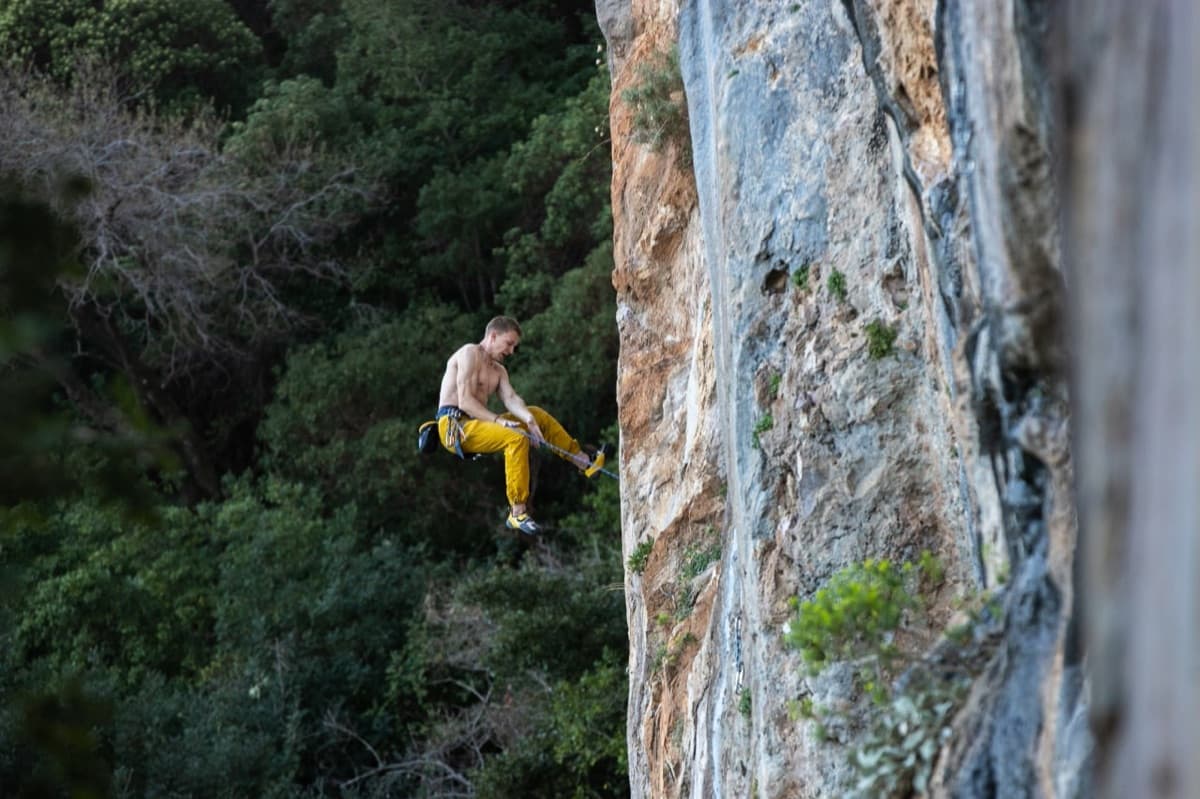
One of the most effective methods is to practice falling. The more you fall, the less you fear it. Falling becomes routine.
7. Pain and the Fear of Falling
Many fear falls because they associate them with pain. It's important to distinguish real risk from imagined danger.
Key point: the fear of falling often comes from lack of trust in the belay.
When you trust your belayer and know that the fall is safe, fear decreases.
Ask yourself:
- What will actually happen if I fall?
- Is there a chance of hitting something?
- Is the belay reliable?
- Is there any risk to my partner?
Rational analysis often shows that the situation isn't nearly as dangerous as it feels.
8. How Fear Manifests
1. Paralysis and Procrastination
Fear can cause paralysis -- freezing mid-route, unable to move. Or procrastination -- knowing you need to commit, but stalling, "testing" holds, adjusting chalk... all instead of moving.
Example: You're halfway up the route, tension rising, fear building. Instead of committing, you start fidgeting -- adjusting your grip, searching for alternatives. It creates an illusion of action, but in reality, you're just burning out.
2. Half-Measures
One of the biggest traps is trying without full commitment. When you execute a move "half-heartedly," fear only grows.
Every move should be decisive.
Conclusion: Most Barriers Are in the Mind
Our brains want to save energy and avoid danger. But growth begins when we take control of our thoughts and fears. Fear is a mechanism -- and it can be used to your advantage.
Practical Guidelines
- Simplify -- Create a safer environment where you can show your mind that this won't kill you.
- Practice controlled falls -- Start small and gradually increase height.
- Control your breathing -- Slow it down, release tension before committing to a move.
- Don't freeze -- If you feel paralysis -- take one step, move.
- Commit fully -- Once you decide to move -- go all in.
Fear isn't something to eliminate -- it's something to understand and train, just like strength or technique.
FAQ: Fear of Falling in Climbing
Don't want to sort through all these details yourself?
Get Your Personalized Training Plan