When we fail to hold onto a hold, most of us instantly blame one thing -- finger strength. But is that really the main reason? Let's dig a bit deeper and look at the problem through the lens of physics and force application -- how exactly we interact with a hold and what we can actually influence.
The Complete Formula for Friction Force
F_fr = mu * (F_grav * cos(theta) + F_press)Where:
- F_fr -- friction force
- mu -- coefficient of friction
- F_grav -- gravitational force (your weight)
- theta -- angle of the hold surface
- F_press -- force you actively apply by pressing or squeezing the hold
This formula explains the resulting friction force -- what keeps you on the wall -- and helps visualize why pressing into the hold and body positioning matter so much.

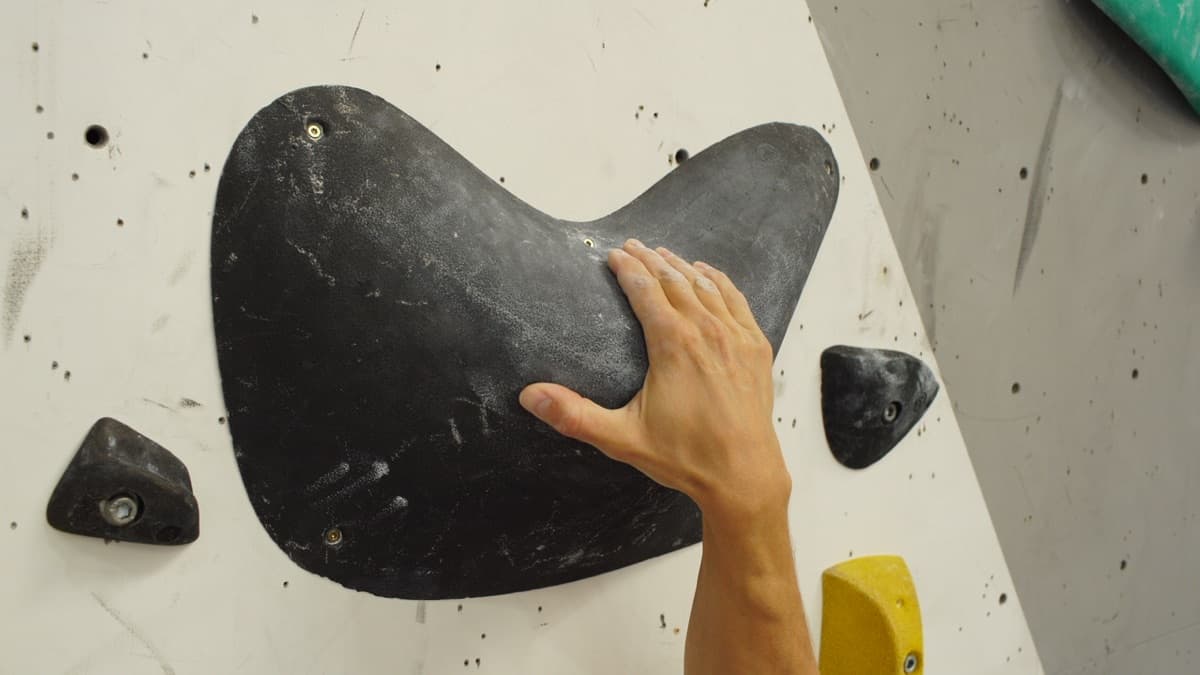
Visual breakdown of friction force components: gravitational force (F_grav), pressing force (F_press), and the resulting friction force (F_fr) that keeps you on the wall.
1. Coefficient of Friction (mu)
What it is:
It depends on the materials in contact -- in climbing, that's your skin or climbing shoes against the hold's surface.
How to improve it:
- Clean hands and holds: Dust, grease, and chalk buildup reduce friction.
- Chalk: Keeps hands dry, improving grip consistency.
- Footwear: Quality rubber with high friction properties makes a big difference.
- Temperature: Cooler conditions often feel "stickier" -- sweat evaporates better, and rubber performs more predictably.
2. Gravitational Force (F_grav)
What it is:
Your body weight acting downwards -- constant and defined by your mass x 9.8 m/s^2.
How to influence it:
- Long-term: Reducing body mass will reduce gravitational load.
- Short-term: Redistributing weight through efficient technique -- shifting weight to your legs -- lightens the load on your arms, even though gravity itself remains constant.
3. Hold Angle (theta)
What it is:
The inclination of the hold affects how gravity splits between normal (pressing into the surface) and tangential (sliding) components. The steeper the wall, the less friction you have to rely on.
How to influence it:
- Body positioning: Keeping your body close to the wall increases the normal force and therefore friction.
- Use your legs: Adjusting your feet placement can reduce the effective angle and share the load.
4. Pressing Force (F_press)
What it is:
The active force you apply -- pushing, squeezing, or pulling into the hold.
How to influence it:
- Grip technique: Engaging fingers correctly increases normal force.
- Body tension: Good core control allows better pressure distribution.
- Strength development: Finger and upper-body training help you generate more pressure on demand.
Summary
| Parameter | Can Be Changed | How |
|---|---|---|
| mu -- Friction coefficient | Immediately | Clean hands, good shoes, chalk, temperature awareness |
| F_grav -- Body weight | Long-term | Reduce body mass, efficient weight distribution |
| theta -- Hold angle | Instantly | Adjust body position and foot placement |
| F_press -- Pressing force | Both | Short-term through technique, long-term through strength training |
Quick Self-Check: What Can You Improve Right Now?
- Are my hands and holds clean? Sweat, dust, and chalk buildup can drastically reduce friction.
- Am I using my body correctly? Is my torso close to the wall? Am I shifting weight to my legs? Can I adjust my angle to ease load on my fingers?
- Am I pressing hard enough? Sometimes the issue isn't strength but application of pressure.
- Do my shoes grip well? Poor rubber or worn soles can undermine everything else.
If you've checked all of the above and still struggle -- it's time to focus on long-term work: finger strength, body control, and overall conditioning.
Final Thoughts
This isn't a scientific paper -- it's a practical model. The formula may be simplified, but it perfectly illustrates the interaction between friction, pressure, and angle -- and why pressing into the hold is crucial.
On overhangs (theta > 90 degrees), the dynamics change slightly, but the idea remains the same: friction is your ally, and understanding it helps you climb smarter, not just stronger.
Don't want to sort through all these details yourself?
Get Your Personalized Training Plan