Most training plans die in week three. Not because the climber got lazy and quit. Because it was never a plan. It was a list of exercises.
I have spent years watching how people build their climbing training. The most common mistake is not that someone trains too little. Usually it is the opposite. They train a lot, hard, and differently every time. Campus board to failure today, hangs on an edge tomorrow, three hours of bouldering the day after because the mood was right. There is load. There is no system.
A training process is not a calendar of hard sessions. It is managing how your body adapts over time.
Your body is an organism, not a machine
You can load a machine the same way every day and it gives you the same output until it breaks. The body does not work like that. The body is a living organism that responds to what you do to it.
And here is the part most people miss: you do not get stronger during the session. During the session you break tissue down. You get stronger afterward, in recovery, when the body rebuilds what the load demanded and a little more.
Training is a signal. Growth is the response to that signal. If the signals come with no pauses and no logic, the body never catches up. It starts defending itself. And it defends the thing that breaks easiest first: in climbing that is fingers and elbows.
Progress does not live in the load. Progress lives in the adaptation between loads.
You cannot chase everything at once
The body can adapt. It just cannot adapt to everything at the same time.
Strength, power endurance, aerobic base, fingers, technique. Try to push all of it in one week and you get none of it. The signals conflict. The body hears "get more powerful" and "get more enduring" at the same time, and does neither well.
So a good process spreads these qualities across time. This is called periodization. It sounds complicated, but the idea is simple: at any given moment training has one main priority, and everything else is kept ticking in the background.
In our logic that is a sequence of phases:
- Test and plan. Where it all starts: where you are right now on strength, fingers, and endurance, where the weak spots are, and where you are going. Skip this and you build blind.
- Base. Aerobic work, ARC, volume of easy climbing. We pour the foundation everything else will sit on. Boring. Necessary.
- Build. Strength and power endurance. This is where real intensity shows up: fingers, power, work close to the limit.
- Integration. We turn the stored qualities into actual climbing. Strength becomes the ability to send a route, not just to hang off a board.
- Peak. Freshness, precision, projects. The body rested and loaded for the main goal.
- Deload. The step most people skip. Load backs off, and that is exactly when the work of the whole cycle lands. The next cycle starts from a higher point.
Each phase sets up the next. A peak without a base is a house without a foundation. Looks fine right up until the first real load.
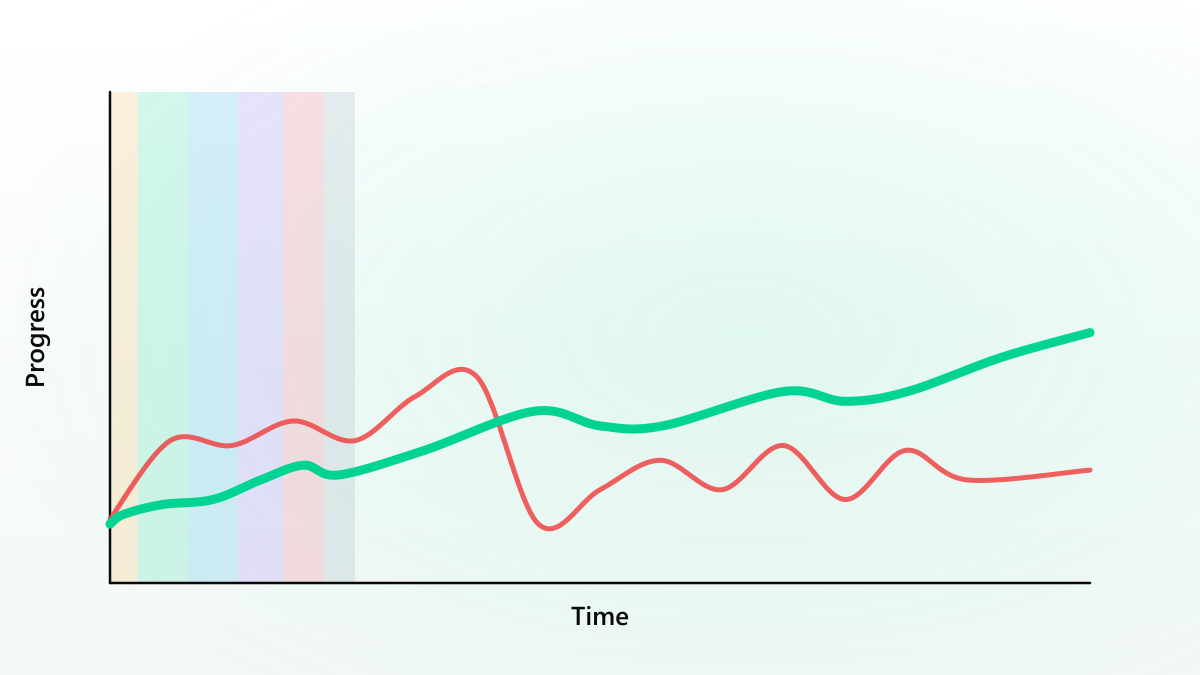
Here is how those phases stack up when you zoom out to months.
Chaos vs structure over months
Same start, same effort. Chaos plateaus and dips on injury. Structured work climbs in cycles, each one starting higher than the last.
Swipe the chart to see all four cycles.
Four weeks, not one session
The smallest unit of the process is not one session. It is a block. Usually four weeks, a mesocycle.
Inside the block the load is not linear. For three weeks you push load up gradually, the fourth is a deload. And here is the most counterintuitive part for most people.
A deload week feels like a step back. It feels like slacking off and losing fitness. In reality that is the week when the work of the previous three lands. You do not train for the sake of training. You train for adaptation, and adaptation happens when the load backs off.
I ignored deloads for years. I thought they were for people who were weaker. I paid for it with injuries and plateaus. The body turned out to be smarter than my ego.
Every session carries one signal
Inside the week each session has a dominant stimulus. ARC, endurance, power endurance, finger strength, max strength, technique, specific climbing.
That does not mean a session does only one thing. It means a session has one clear point. When you show up to "just climb", the body gets a blurry signal and answers blurry. When the session has a focus, the body's answer is precise.
A hard day should be genuinely hard. An easy day honestly easy. The most useless zone is the permanent "medium": too hard to recover from, too easy to grow from.
Listen to the load, not just the plan
A plan is a hypothesis about how your body will respond. Life keeps interfering with that hypothesis: sleep, work, stress, bad nights.
So the process is also managing load by what is actually happening. We sort the state into zones. Green: all good, load it. Yellow: careful. Orange: pull back. Red: stop, recover.
The main signal in climbing is fingers and connective tissue. Muscles recover in days, tendons and ligaments in weeks. If your fingers ache, that is not a reason to push through. It is a signal worth more than any plan. The route will wait. A pulley you tear will not.
The process matters more than any single session
Climbing teaches the long game better than almost any other sport. A route that looks impossible today becomes a warm-up after half a year of the right work. But only if the work was a process, not a string of random heroic sessions.
A good session is not the one that leaves you barely able to reach the locker room. A good one is built into the system and moves you toward the goal without breaking you on the way.
The body is a living organism. Give it clear signals and time to answer, and it grows. Bury it in chaos and it just survives.
So how is your training process built: a system, or a list of exercises?
Want a plan built around this, for your level, goals, and real schedule?
Get Your Personalized Training Plan