One of the biggest mistakes in conversations about finger training is that everything gets thrown into one pile. People just say: “you need to hang,” “hangs build strength,” “hangs make your fingers stronger.” But that is far too superficial.
When people talk about finger training in climbing, it very often gets reduced to one idea: hangboard (fingerboard), hangs, and more hangs. But finger strength is not just one thing. And if you do not separate which quality you are actually training, it becomes very easy to get stuck and spend months doing work that is no longer giving you much progress.
Yes, hangboard hangs can be useful. But the question is not whether they are useful at all. The question is what exactly they develop, how long that works, and what to do when progress stops.
What finger strength in climbing actually is
Finger strength is not one single quality. There are at least several different abilities here:
- Peak Force (PF)
- Contact Strength / Rate of Force Development (RFD)
- Maximum Strength in the alactic zone (Fmax ala)
- Local Strength Endurance (CF)
And each of these qualities requires different protocols. For a deeper look at how force actually transfers to the hold, see what affects grip strength in climbing.
PF and RFD are linked to very short efforts, usually under one second. This is about how much force you can produce at all and how quickly you can switch it on.
Fmax ala is heavy short-duration work, most often in the range of roughly 5–30 seconds. Here, the key is being able to hold a very high level of force without significant metabolic fatigue.
CF is more about repeated efforts in series, where we can talk about local endurance, fatigue resistance, capillarization, and the stronger role of aerobic mechanisms.
And this is where the most important part starts: you cannot talk about finger training as if all of this is developed in the same way.
What classic hangboard hangs actually develop
This is exactly where the confusion begins.
A lot of people think in a very simple way: if I hang, that means I am developing finger strength. But that is too primitive.
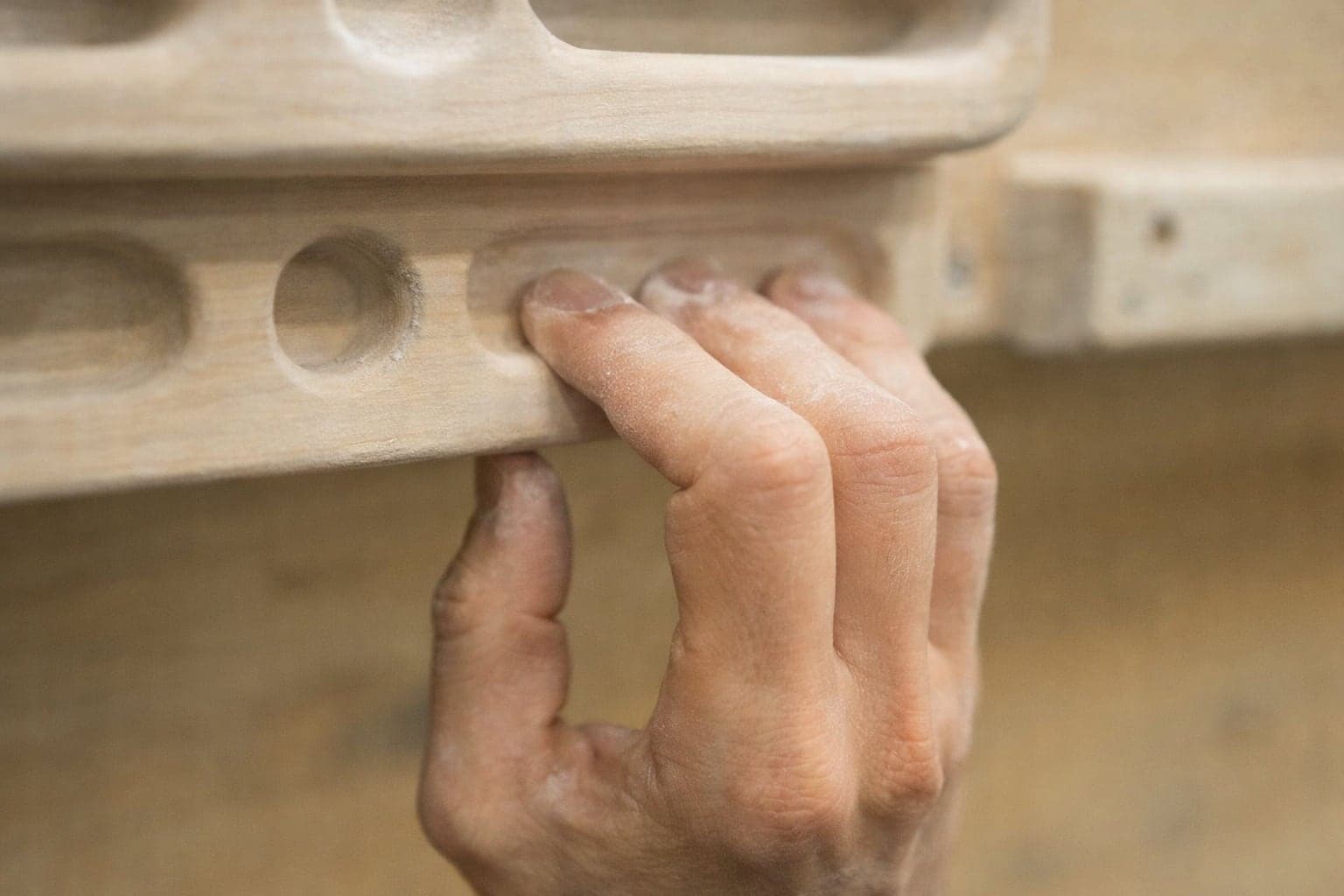
Yes, classic static hangboard hangs really can develop finger strength. Yes, they are a valid tool. But they are not a universal answer to everything. And they definitely do not work forever with the same effectiveness.
Static hangs can:
- develop specific grip strength
- improve tissue adaptation to load
- help develop maximal force in certain protocols
- maintain specific finger readiness for climbing load
But the problem starts when someone turns one protocol into a ritual and repeats it for months without changing anything.
Why the same hangs stop working
When someone spends months doing the same static hangs, they often think they are still “training fingers.” In practice, it does not work like that.
Yes, static hangs can develop strength. Yes, they are a useful tool. But only as long as that stimulus is new for you and as long as it is still pushing adaptation forward.
The problem begins when you hit a plateau.
When you keep doing the same protocol for too long, the muscles, nervous system, and tissues have already taken almost everything they can from it. Strength progress slows down or stops. But the load itself does not disappear. You are still stressing the fingers, tendons, ligaments, and the entire connective tissue system.
And if there is no proper balance between load and recovery, the risk of overload and injury becomes higher.
So the mistake is not that hangs are useless. The mistake is that climbers keep doing them out of inertia, even when that format has already stopped producing noticeable gains.
That is exactly why the phrase “just hang more” is not very good advice.
Why a plateau in finger training is a normal stage
It is very important to understand this: a plateau does not always mean that you are not trying hard enough. Very often, it simply means that your body has already adapted to that specific type of load.
If you are not progressing, there is no point in endlessly repeating the same static protocol and hoping it will suddenly start working again. Usually, it will not.
At best, you will maintain your current level. At worst, you will start accumulating fatigue, recovering worse, and increasing your injury risk.
So after a plateau, the task is not to push harder through the same thing. The task is to change the stimulus.
What to do if progress from hangboard training has stopped
Change the stimulus.
That can mean:
- changing the hang duration
- changing the intensity
- changing the volume
- changing the number of sets and the rest periods
- changing the training format itself
- and sometimes moving away from classic static hangs entirely and using another type of loading
Because the real question is not whether you are doing hangs or not. The real question is what quality you are training right now, whether it is producing progress, and whether that stimulus is still developmental rather than just maintaining what you already have. If you're looking for a structured approach to long-term climbing progress, this guide on safe progression in climbing covers how to build that foundation without burning out.
The main question about finger training
Here is a simple question you can use to quickly test almost any coach or expert:
What do classic static hangboard hangs develop?
Wrong answer:
“Only muscles” or “only tendons.”
Correct answer:
Static hangs can develop strength and specific tissue adaptation. But if you use the same protocol for too long, they often stop being the best tool for further progress and become more of a way to maintain specific strength and local tissue adaptation to load. After a plateau, it usually makes sense to change the stimulus and shift the focus toward the muscular and neuromuscular component. In many cases, this is more effectively developed through other loading formats, including more dynamic work, rather than endlessly repeating the exact same isometric hangs.
As long as the stimulus is new, you grow. When adaptation to that stimulus is finished, simply continuing to do the same thing becomes pointless.
If there is a plateau, you should not just keep suffering through it. You need to review the protocol, change the stimulus, and look for a new loading format that can drive progress again.
Because in finger training, the main question is not whether you are hanging at all, but what exactly you are developing right now and what your progress is actually supposed to come from.
Conclusion
To put it simply, hangboard hangs are not magic and they are not a universal answer. They are just a tool. A good tool, but only when it is used for a specific purpose and at the right time.
The mistake is not that people hang. The mistake is that so many climbers keep doing the same protocol for too long without asking themselves the main question: is this still developing me, or am I just mechanically repeating a familiar load?
That is where real, mature finger training begins.
Want a training plan that actually adapts to where you are right now?
Get Your Personalized Training Plan