I've seen enough finger injuries over the years to know one thing. Almost all of them came from the same mistake: someone decided they were ready for max hangs before their body was.
That is the whole conversation about hangboard (fingerboard) training for beginners in one line. Muscles adapt fast. Tendons, pulleys, the connective tissue that actually holds your finger together, they adapt much slower. The gap between those two timelines is where people get hurt. I've watched climbers spend a year or two out of the sport because they tried to skip it.
A hangboard is not dangerous. Using it badly is. And a lot of what passes for “beginner hangboard training” online is just a heavy session with the word “beginner” pasted on top.
The wrong question and the right one
When someone asks me how to start training on a hangboard, they usually want to know the fastest way to add max hangs to their week. That is the wrong question.
The right question is simpler: how do I build stronger fingers without wrecking them?
Those are two different training plans. One of them works. The other one sends you to a physio.
Who this article is for
This article is for climbers who:
- have been climbing regularly for at least six months
- can hold a half-crimp and an open-hand grip without pain
- have no sharp pain in the finger, wrist, or elbow right now
- want to train fingers systematically, not randomly
If you've had an A2 or A4 pulley episode, morning stiffness in a specific finger, a click, local swelling, or the feeling that a finger just doesn't hold, fix that first. Hangboarding on a symptomatic finger does not make it stronger. It buys you more symptoms.
Two more lines that save injuries. If you're under about 16, do not hangboard at all. And even past 16, avoid weighted hangboarding until skeletal maturity, typically around 18. Finger loading on unfused growth plates can cause epiphyseal fractures, and that is not reversible. And monos or two-finger pockets are off-limits for this whole 13-week block, regardless of phase. The pulleys on two fingers cannot safely take what four can.
Why people get injured on a hangboard
Almost always, the problem is not the hangboard. It's how people use it. The most common mistakes:
- too small an edge, too early
- full crimp as the main training grip
- jumping from normal climbing straight into heavy hangs
- no deload weeks
- changing weight and edge size at the same time
- no supporting work for forearm extensors, shoulders, and core
In our 13-week hangboard program, full crimp is not the default training grip. And when the strength block starts, only one variable changes at a time: either the weight, or the edge size, never both. That rule is not decoration. It is what keeps tendons ahead of the load.
The four signals you must track
On every hangboard session, four things tell you whether you're training or injuring yourself:
- RPE. How hard the hang actually felt on a 1-10 scale.
- Contact quality. Calm grip, or shaking, shoulder collapse, skin slipping?
- Next-morning symptoms. Any pinpoint pain, stiffness, local irritation.
- Recovery between sessions. 48 to 72 hours in Base and Build. In Integration and Peak, allow up to 96 hours between heavy finger sessions.
If any one of these goes into the red, you are not ready for the next step. It is that simple.
How to warm up before a hangboard session
Before any hang, the same logic: body first, forearms and antagonists next, shoulder blades and core after that, and only then the fingers.
A basic 12 to 15 minute warmup looks like this:
- Light cardio
- Finger extensors with a band
- Forearm pronation and supination
- Scapular pull-ups or an active hang on jugs
- Dead bug or hollow hold for core activation
- A progressive ladder on the board: jug for 10 seconds, then a big edge open-hand for 10 seconds, then the target edge for 5-7 seconds with a lot of foot help
Two small prerequisites that get ignored and cost a lot of sessions: nails trimmed short so the pad actually sits on the edge instead of levering the finger into a deeper crimp, and hands warm before the first real set. Cold fingers load the pulleys differently. If your hands are cold, warm them in water or in pockets first. Do not open the session on cold hands.
That is the same warmup structure our 13-week program uses. Nothing fancy. Tissue brought up slowly, so the first real set is not the first real load.
The progression: five phases that match our 13-week program
The safest path to max hangs is not a harder hang. It's a sequence. Our 13-week hangboard strength program is built around exactly five phases:
Base → Build → Integration → Peak → Consolidation
Each phase has a specific job. Skip one and the next one breaks. Here is what each phase actually does and the parameters to aim for.
Phase 1: Base (weeks 1-4), tissue prep
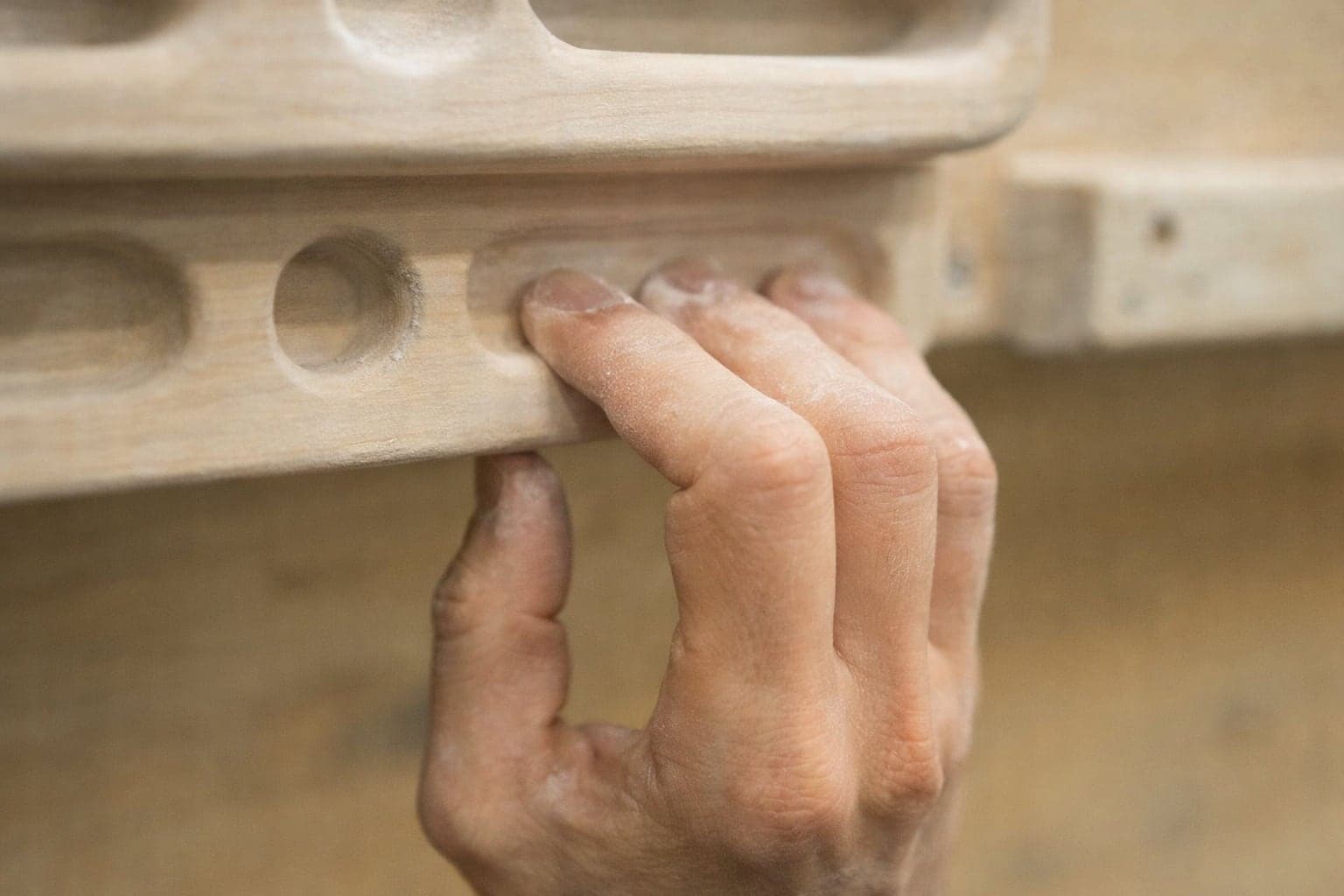
Two to three sessions per week. Light load. Open-hand or half-crimp on a comfortable edge, typically 20 mm flat (or the most comfortable edge on your board, never smaller than 18 mm). Density hangs in a 10/20 format: 10 seconds of hang, 20 seconds of rest. Feet helping, no added weight.
Start small on volume and build up. Week 1: 2 blocks of 5 reps. Weeks 2-3: 3 blocks. Week 4: 4 blocks of 5-6 reps, only if the earlier weeks produced no symptoms. 2-3 minutes rest between blocks.
Target RPE: 5-6 out of 10.
Success in this phase is not how hard you hung. It is boring on purpose: did you finish both sessions this week with no pinpoint pain, no next-morning stiffness, no collapse of form? If yes, change one variable the following week. Either one more rep per block, or slightly less foot support, or a couple of seconds more on the hang. One change per week. That is the whole progression rule.
Stay in Base as long as any red flag shows up. Most climbers want to leave Base after one week. Most climbers should not.
Phase 2: Build (weeks 5-7), capacity and first heavy exposure
Two sessions per week. Load goes up, rest goes up with it, and heavier tools come in. Longer repeaters for capacity, 7:3 repeaters for specific loading, and the first weighted hangs at roughly 70-80% of your 10-second max, progressing toward 85% only at the end of the block. Half-crimp becomes the primary grip, open-hand stays secondary.
Target RPE: 7 to 7.5, climbing to 8 by the end of the block.
Still not max hangs. This is where most people try to shortcut. Here, the body is learning to tolerate high local tension while you still have margin. Repeaters build capacity. Weighted hangs introduce the shape of strength work without the dose being destructive. One variable at a time. Always.
A deload week is built into Build for a reason. The work compounds fast, and if you skip the recovery, the Integration phase will crack.
Phase 3: Integration (weeks 8-10), first real max hangs
This is where real max hangs show up. Build introduced weighted work at 70-80%. Integration is where you actually reach 85-90% of the 10-second max. Typically 4 to 5 sets, 10-second hang, 3.5 to 4.5 minutes of rest. Half-crimp on a 20 mm edge. Do not drop to 18 mm unless you are climbing V5 or 6c+ consistently and the 20 mm edge already feels controlled.
Target RPE: 8 to 8.5.
And now the other half of Integration: you take that strength back into climbing. Limit bouldering and limit picks in the same weeks. The point is no longer isolated finger strength. The point is that the finger you built in Base and Build can now produce force inside a real movement.
What a good max hang looks like:
Calm contact. You hold the position for the whole interval. You feel effort, not panic. The last seconds do not turn into a fight for survival.
A bad max hang is obvious. Face, neck, and shoulders brace for rescue. Fingers roll into the edge. Contact goes dirty. Next morning, something aches. That is not strength training. That is tissue damage with a score.
If your max hangs look like the second version, you are not in Integration. You are in Base again.
Phase 4: Peak (weeks 11-12), max expression
Short, sharp, infrequent. Recruitment work on the board and target-grade attempts outside. This is the block where people try to personally record, and that is fine, as long as Base, Build, and Integration were actually done.
Peak is not a protocol to copy. It is the top of a stack. If the stack below is missing, this block is where injuries finally surface.
Phase 5: Consolidation (week 13), deload as part of growth
One week. Volume drops to around 60-70% of the previous block. RPE drops to 5. Everything still moves, just lighter.
Consolidation is not a reward and not a rest. It is how the adaptation finishes. The signal you sent during Peak becomes hypertrophy and tendon remodeling during Consolidation. Skip it and you do not get the benefit of the block. You just get the fatigue.
In our 13-week program, the deload sits between blocks, not after pain shows up. Recovery is part of the plan, not an emergency measure.
How to know you're ready for max hangs
You are ready for real max hangs when, for 4 to 6 weeks in a row:
- hangboard sessions produce no pinpoint pain
- RPE 7-8 hangs leave no problem the next morning
- your half-crimp stays organized without shoulder and torso collapse
- you can reduce foot help or add small amounts of load with no symptom spike
- your normal climbing does not get worse because of the hangboard
If any single one of those is missing, you do not need a new strength stimulus. You need more base.
The work around the hangboard
Hangboard training without the work around it is a bad trade. At minimum, your week needs forearm extensor work, pronation and supination, scapular and posterior shoulder work, and basic anti-rotation core. I won't list sets and reps here. The point is that those exercises have to be in the plan. In our 13-week program they are built into every warmup and kept as maintenance throughout the cycle.
Fingers are not a standalone project. They sit at the end of a chain, and when the chain is imbalanced, the weakest link is almost always a pulley.
Common mistakes on the way to max hangs
Almost every finger injury I've seen came from one of these:
- jumping to max hangs after one or two weeks of training
- using full crimp because it feels stronger
- testing a max every week
- trying to make up for missed sessions by adding volume
- ignoring morning stiffness
- doing a heavy hangboard session the same day as limit bouldering
One more, which sounds minor and is not: never catch up on a missed session by adding reps to the next one. Come back slightly below where you left off. The 13-week program is explicit about that.
If you want the bigger picture on how finger strength actually transfers to the wall, this piece on grip strength factors is worth reading next. And if you're wondering how hangs relate to the long-term plateau problem, this one on why hangboard progress stalls covers that directly.
Red flags: stop the session
Stop immediately if any of these show up:
- sharp, localized pain in a finger
- the feeling of a click or pop
- fast-onset swelling
- a clear loss of grip strength inside the session
- pain you can point to with one finger
- pain that gets worse set to set
- numbness or tingling in a finger (that is neural, not muscular, and needs its own check)
- skin failure mid-set: finish the current set safely, then stop. Do not tape over a flapper and keep loading
Two more situations where the best decision is to not train at all: you are sick, or you slept less than five hours. The tissue cost of a hard hangboard session on a bad system is much higher than people think. A skipped session costs nothing. A torn pulley costs months.
Diffuse forearm fatigue is one thing. Pinpoint pain in a pulley is another. Learn the difference. One lets you train tomorrow. The other can put you out of the sport for six months.
The main rule
The safe road to max hangs is not “add weight faster.” It is a sequence.
Tolerance → capacity → moderate strength → max hangs
That is how fingers get a stimulus they can actually survive and turn into adaptation. It's why our 13-week program is structured the way it is. By the time you reach real max hangs, your fingers have been prepared for them. That is the only version that works long term.
Hangboard training for beginners is not about how hard you can pull. It's about whether your fingers can still pull that hard six months from now.
How about you?
Want a hangboard plan built exactly around this progression?
Get Your Personalized Training Plan