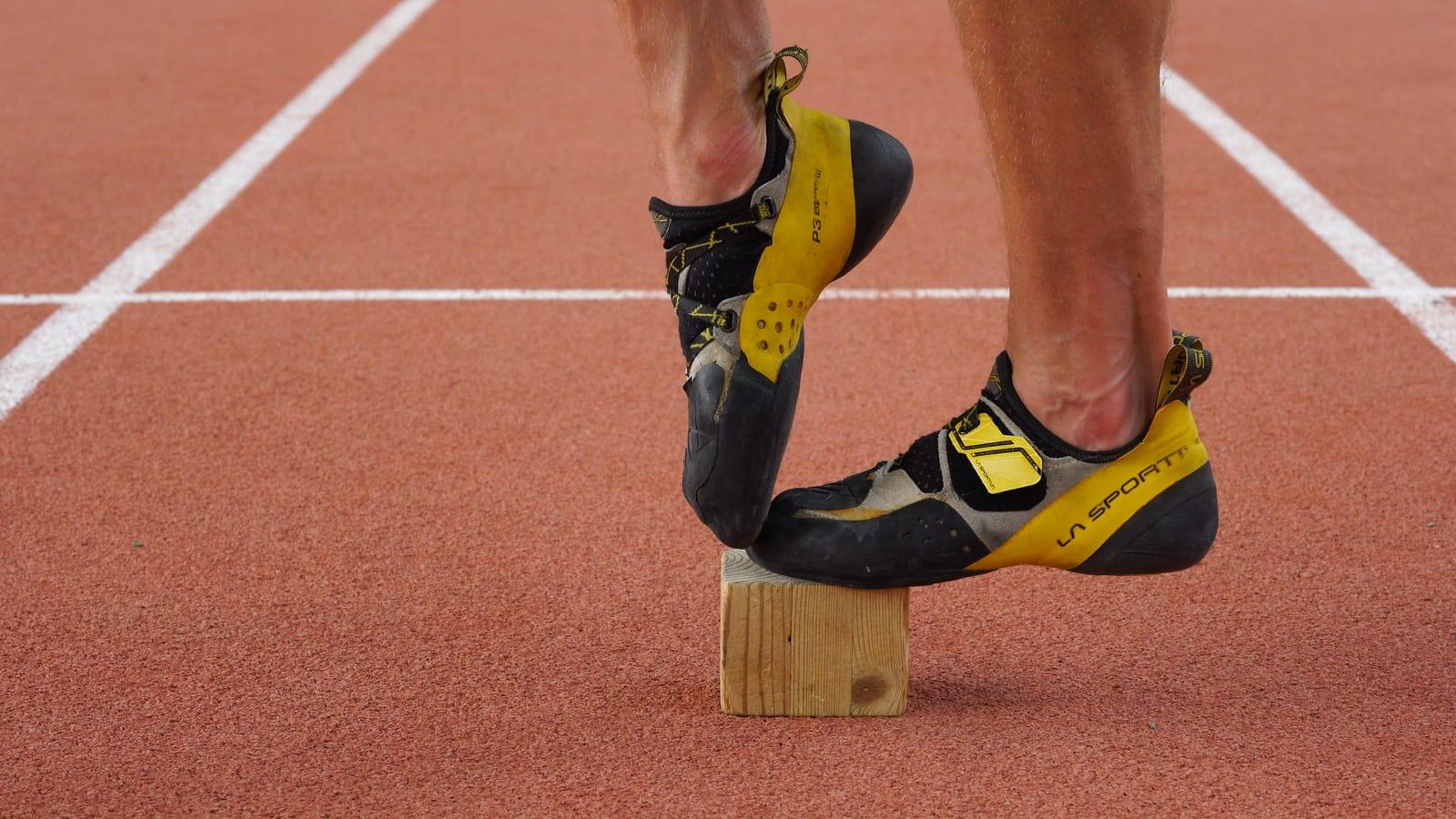
We hear all the time that footwork matters.
But let's look at it once more: why it really matters, how to focus on it, and what to do about it.
In my experience, up to 7b almost every climber I have worked with is limited not by finger strength but by footwork and body position on the wall.
We tested finger strength, and as a rule it was already enough to climb at an advanced level. The problem was somewhere else: how well they controlled their body and applied that strength.
Why does this happen? On easy routes you can still control every placement. Make the route a little harder and the load on your arms goes up, your attention moves to your hands, and your climbing footwork is left on its own. And when nobody is steering, the feet do what they have done your whole life.
Your feet already have a habit
They walk. On flat ground, straight ahead, left, right, left, right. That is the only program they have been running for decades.
Unless another sport taught your legs to lift high and push off from strange positions, the wall asks for something your body simply does not have stored. So under load, the brain goes back to the default. If footwork is not trained to the point where it runs on its own, it drops to second place exactly when you need it most: when the route gets harder.
Technique is learned in three stages: first you think about every detail, then the movement works as long as you watch it, and only at the third stage does it run on its own. I covered these stages in the article on a bouldering training plan for beginners. Footwork that has not reached the third stage runs on attention. And under load, attention goes to your hands.
From 6a to 7b the problem does not go away, it changes
At 6a you can come back to good foot placement in almost every session.
Above 6a the problem is still there, only the model of how the foot works changes.
On easy routes the job of the foot is simple: press down and move left and right. On harder routes the angle of the pressure into the hold changes too. For example, you need to press the foot into the hold at 45 degrees. That is unusual for the body, and it is unusual for the brain. We do not do this anywhere in normal life. Nobody walks to the shop pushing their toes into the pavement at an angle.
So if you do not practice it, your body will not do it by itself. That is why footwork needs deliberate focus, long after your first months on the wall.
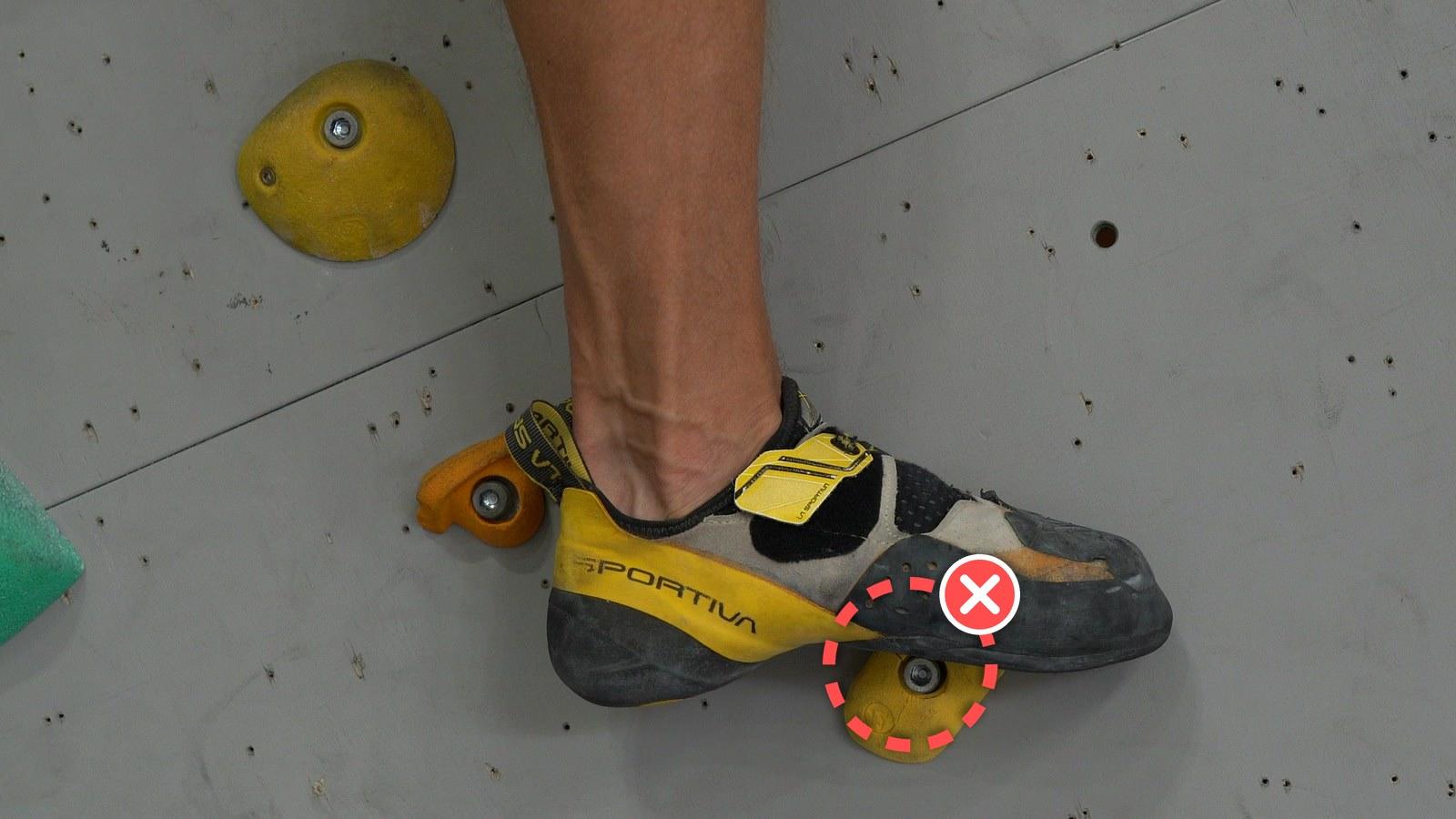
The front of the foot, not the middle
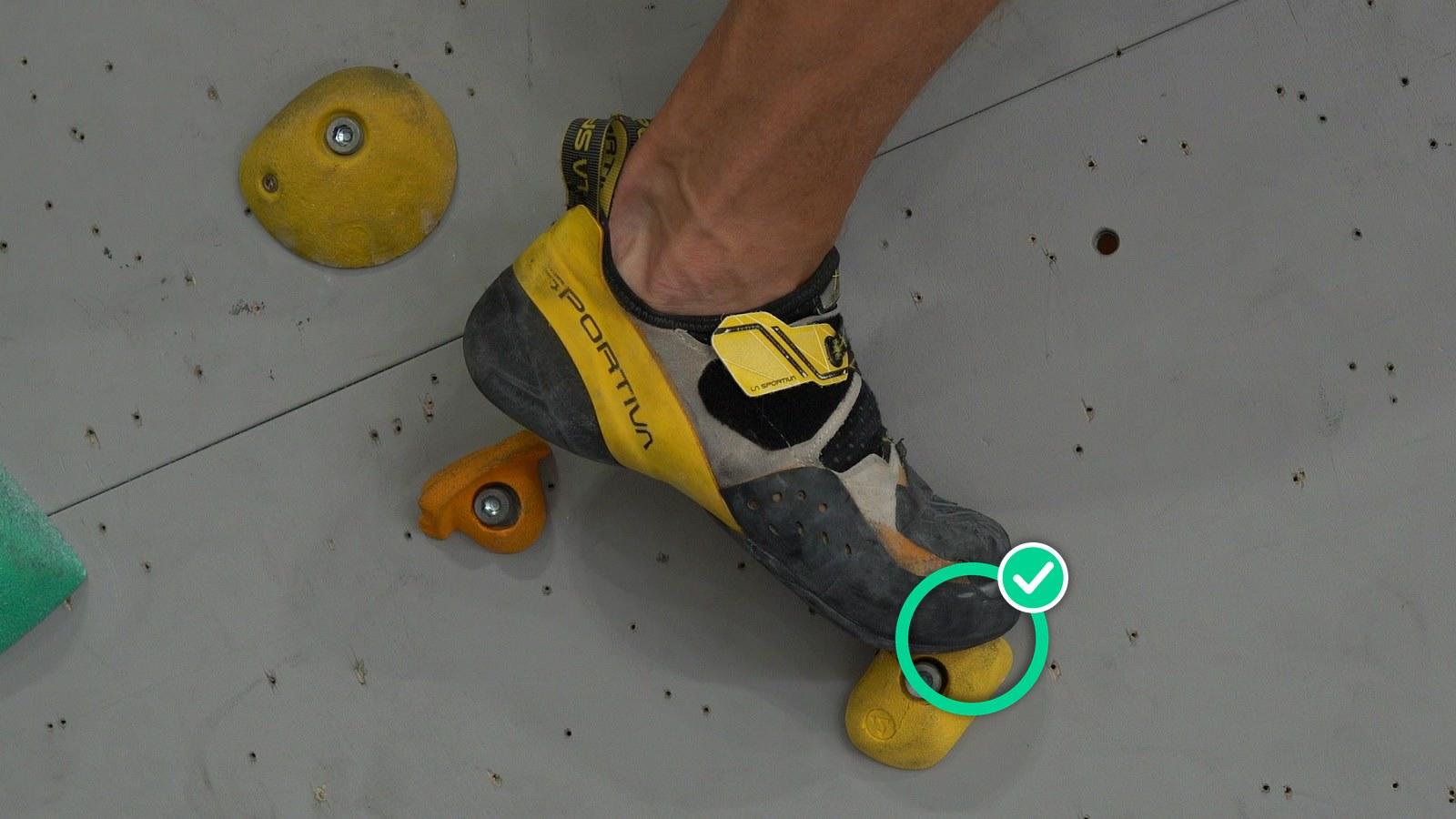
A reminder of the basic rule of placement: always the front of the foot, the toe. The middle of the foot does not work. Heel hooks and toe hooks are a separate topic, and they will get their own article.
Standing on the toe lets you control not only a careful placement but a precise one. And precision is what harder routes are made of. The harder the moves, the worse the footholds usually are, and the less sure you are: of the foot, of the move, of the push. Training your placement like this gives you extra confidence, in yourself and in your foot.
The silent feet drill
It seems banal. But many climbers need exactly this one.
Stand next to a climber without technique and you will hear them before you see them. The feet hit the wall. Bang, bang. That means they do not control the placement. The foot goes wherever it lands.
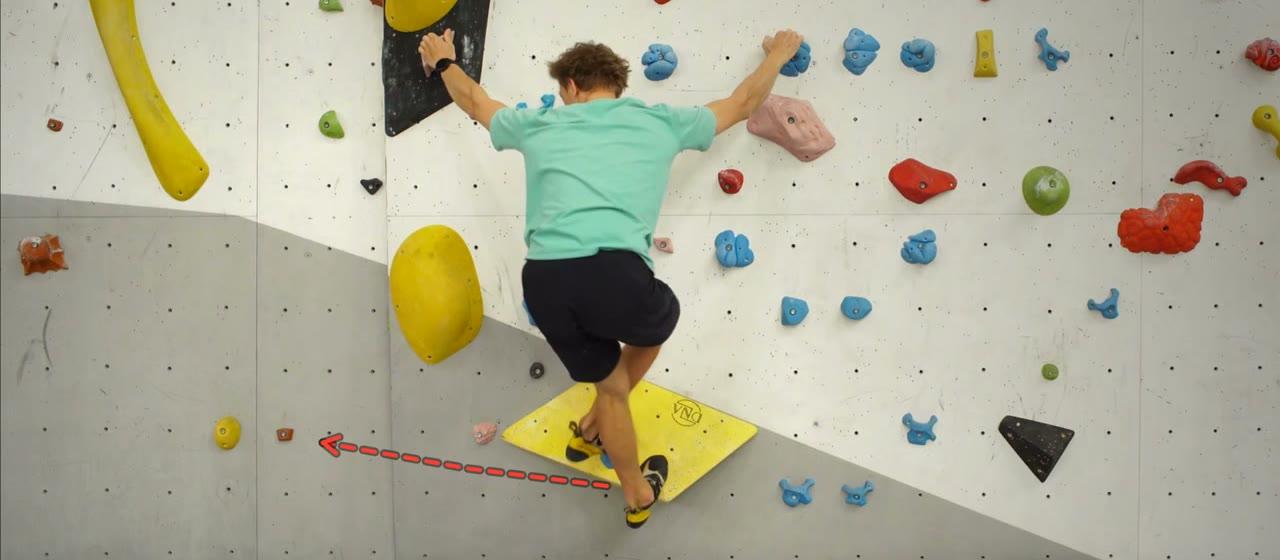
And this is not a beginner problem. I have seen it in climbers up to 7b. In people who have climbed for years it often lives on as a habit: at the start there was no focus on the feet, nobody worked on it, and the noise stayed.
Silent feet gives you a way to place the foot quietly, calmly, smoothly. And to place a foot quietly and carefully, you have to look at it. You have to control it. When you control it and focus on the placement, all the attention of your brain and body goes to putting that foot in the right place.
The more you practice like this, the more your body learns to put the foot straight onto the hold, precisely and calmly, without you thinking about it. That is the whole point. Today it takes all your attention, so that one day it takes none.
Film yourself.
Take an easy route and your phone. Climb it once placing your feet any way they land. Then climb it again controlling every foot, quietly. Watch the two videos one after the other and you will see how much smoother the movement gets.
If you are at the very start and want more of these, I collected ten footwork drills for beginners in a separate article.
Trust in your feet is built, not found
To believe in a foot, it is not enough to put it on a hold once. Trust comes from placing it again and again and seeing that the foot holds. Confidence does not show up by itself, without experience.
That is already a slightly different topic, working with fear. But the answer is the same. If you do not trust your feet, there is no secret weapon that solves it in one session. It does not exist. It is work, session after session.
At 6b-7b this confidence is worth building on purpose. Set aside separate sessions on vertical walls and slabs, where footwork matters most.
I get it: most people would rather come in and climb the Kilter Board or the MoonBoard, hang on the hangboard, train their fingers. But that is usually overhanging terrain, and there the focus is still mostly on your arms. Climbing on vertical walls and slabs teaches you to focus on foot placement: you see how your feet get used to it, and you teach your brain that your feet hold on the holds. The same goes for climbing on a rope.
How we work on footwork in the app
That is why in EternaClimb footwork is not a tip you read once. To progress, the app works on all the systems: strength, body conditioning, technique, finger strength and so on. We develop them with focus, at different frequencies and on different details, so that it all fits together properly. And for that, of course, you need a plan.
Your feet already know how to walk. Teaching them to climb is your job.
So, how loud are your feet?
Want footwork built into a full training plan?
Get Your Personalized Training Plan