EternaClimb · Training Guide
The Core Training Principles
Fifteen principles that decide whether your climbing training compounds - or just tires you out.
Alex Voit - climber and coach. 15 years climbing, 10+ years coaching, personal best 8a+.
Most training plans die in week three because they were a list of exercises, not a system. The body is a living organism. Give it clear signals and time to answer, and it grows. Bury it in chaos and it just survives.
Most climbers do not need to train more. They need to train with a clearer reason. The fifteen climbing training principles in this guide are that reason - the same ones behind every EternaClimb program.
Principle 01 · supercompensation
You get stronger between sessions
You do not get stronger during the session. During the session you break tissue down. You get stronger afterward, in recovery, when the body rebuilds what the load demanded and a little more.
The adaptation you are working for happens on the days you think you are wasting.
Training is a signal. Growth is the response to that signal. If the signals come with no pauses and no logic, the body never catches up.
The rule
Progress does not live in the load. Progress lives in the adaptation between loads.
Principle 02 · progressive overload
Progress in small steps
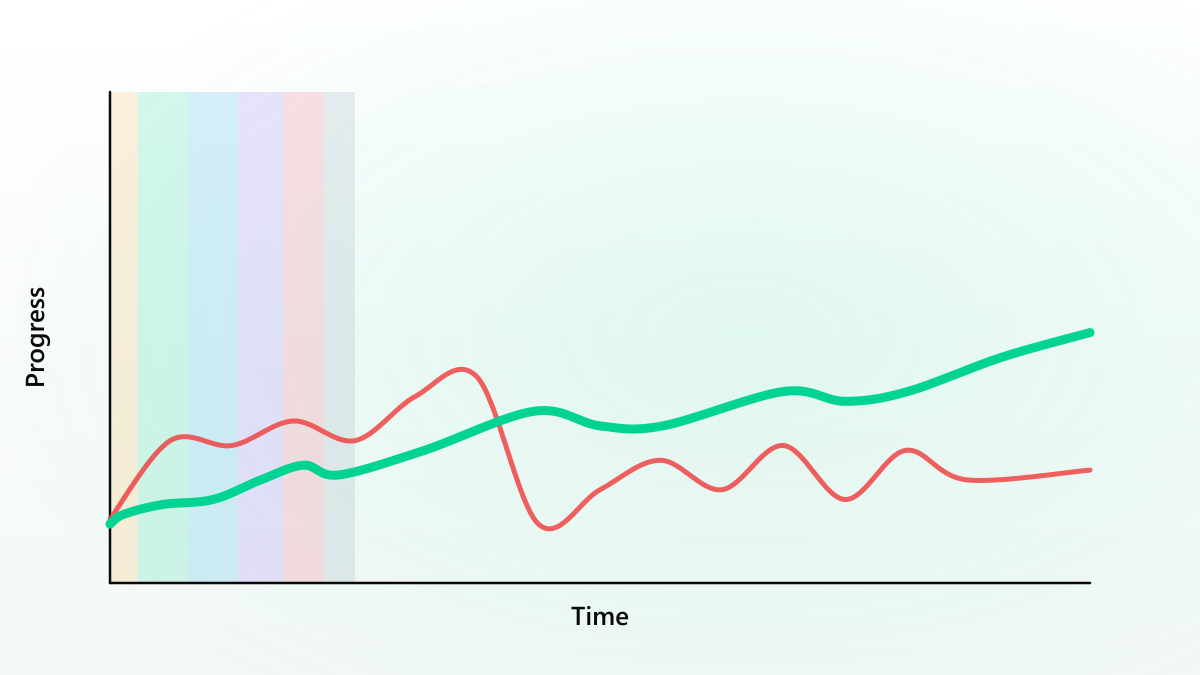
Growth needs overload: a little more than the body is used to. But you cannot, at every session, do more, climb harder, add more load - that is not how it works. If load simply keeps rising, recovery cannot keep up: fatigue accumulates, movement quality drops, progress slows, injury risk climbs.
Small steps win. Progress with added load only when form is clean, and earn the right to harder work over weeks, not days.
The gray line looks faster for three weeks. Then it breaks - and everything after is recovery instead of progress. The green line is never impressive in any single week, and wins every time on a scale of months.
The rule
Progress slowly, with added load only when form is clean. Earn the right to harder work over weeks, not days.
Principle 03 · the danger gap
Tendons set the speed limit
Muscles and coordination catch up fast. Tendons, pulleys, connective tissue - much slower, remodelling 3 to 10 times slower than muscle. You can feel stronger before your fingers are actually stronger, and that gap is where overuse begins.
Injury almost never comes from one bad session. It comes from a pattern: one more hard hang, the same bouldering volume, a week of bad sleep, and a tendon that has not caught up to the muscle driving it. Train with deloads and the story flips: the tendon catches up cycle after cycle, and the gap closes.
The rule
Change one variable at a time: either the weight, or the edge size - never both. One change per week. That is the whole progression rule.
Principle 04 · periodization
Structure beats chaos
A route that looks impossible today becomes a warm-up after half a year of the right work. But only if the work was a process, not a string of random heroic sessions.
The body can adapt. It just cannot adapt to everything at the same time. So a good process gives training one main priority at a time and keeps everything else ticking in the background.
Each phase sets up the next. A peak without a base is a house without a foundation - looks fine right up until the first real load.
The rule
Same effort. A plan turns it into progress that lasts.
Principle 05 · the base and the peak
Volume first, then intensity
Volume creates the fuel that strength and intensity sit on. Without it, any strength-focused training quickly runs into fatigue and regression. And the reverse is just as true: as intensity rises, volume must come down - otherwise fatigue begins to dominate adaptation.
The rule
Maximal strength and endurance cannot be built at high volumes at the same time - one load interferes with adaptation to the other. Pick the phase you are in.
Principle 06 · the four-week block
The deload is where the work lands
The smallest unit of the process is not one session. It is a block - usually four weeks. For three weeks you push load up gradually, the fourth is a deload. It feels like a step back. In reality that is the week when the work of the previous three lands.
I ignored deloads for years. I thought they were for people who were weaker. I paid for it with injuries and plateaus. The body turned out to be smarter than my ego.
The next block starts from a higher point. You do not train for the sake of training - you train for adaptation, and adaptation happens when the load backs off.
The rule
A working deload: cut volume or intensity by roughly 30 to 50 percent, do not test new maxes, and finish sessions noticeably fresher than usual. Bank the adaptation - do not add more stimulus.
Principle 07 · hard days hard, easy days easy
One signal per session
When you show up to "just climb", the body gets a blurry signal and answers blurry. When the session has a focus, the body's answer is precise.
A hard day should be genuinely hard. An easy day honestly easy. The most useless zone is the permanent "medium": too hard to recover from, too easy to grow from.
A sample intermediate week: three clear signals, easier work and rest between them. Many climbers need roughly 48 hours to fully bounce back from a hard session. Do not put the same energy-system focus on back-to-back days, and alternate harder and easier days instead of grinding through equally hard sessions.
The test
Explain the goal of the session in one sentence before you start. If you cannot, you are about to mix stimuli and dilute the result.
Principle 08 · the stimulus map
Know the stimulus you are training
Every stimulus carries its own adaptation. A session is not "climbing plus effort" - it is a signal aimed at one system. If you do not know which system today's work is aimed at, the signals mix and the stimulus smears: no progress, or an injury.
↑ Higher intensity
Max strength & power<15 sec · near max
Shows up as: the hardest single moves - limit boulders, small edges, powerful pulls.
The work: short maximal efforts, with rests long enough to go again at full power.
Power endurance30 sec - 2 min · high
Shows up as: long cruxes and linked hard moves; arms that explode after a few moves.
The work: linked hard moves that pump you on purpose - and teach the forearms to keep firing anyway.
Aerobic power2-10 min · moderate
Shows up as: recovering on holds mid-route, holding pace between hard sections.
The work: sustained efforts just below the redline, learning to recover while still on the wall.
Aerobic base10-30+ min · low
Shows up as: climbing all day and staying fresh across long sessions.
The work: long, easy, unbroken climbing - boring on purpose, while the engine grows underneath.
Longer effort →
Same wall, four different signals. Pumping laps do nothing for max strength, and max hangs do not build your engine. The adaptation follows the stimulus, not the sweat. Which one, how much, and how often - that is what a program decides for you.
The rule
Name the stimulus before the session, and train one quadrant at a time. Mixed signals produce smeared results.
Principle 09 · variability
The same stimulus fades
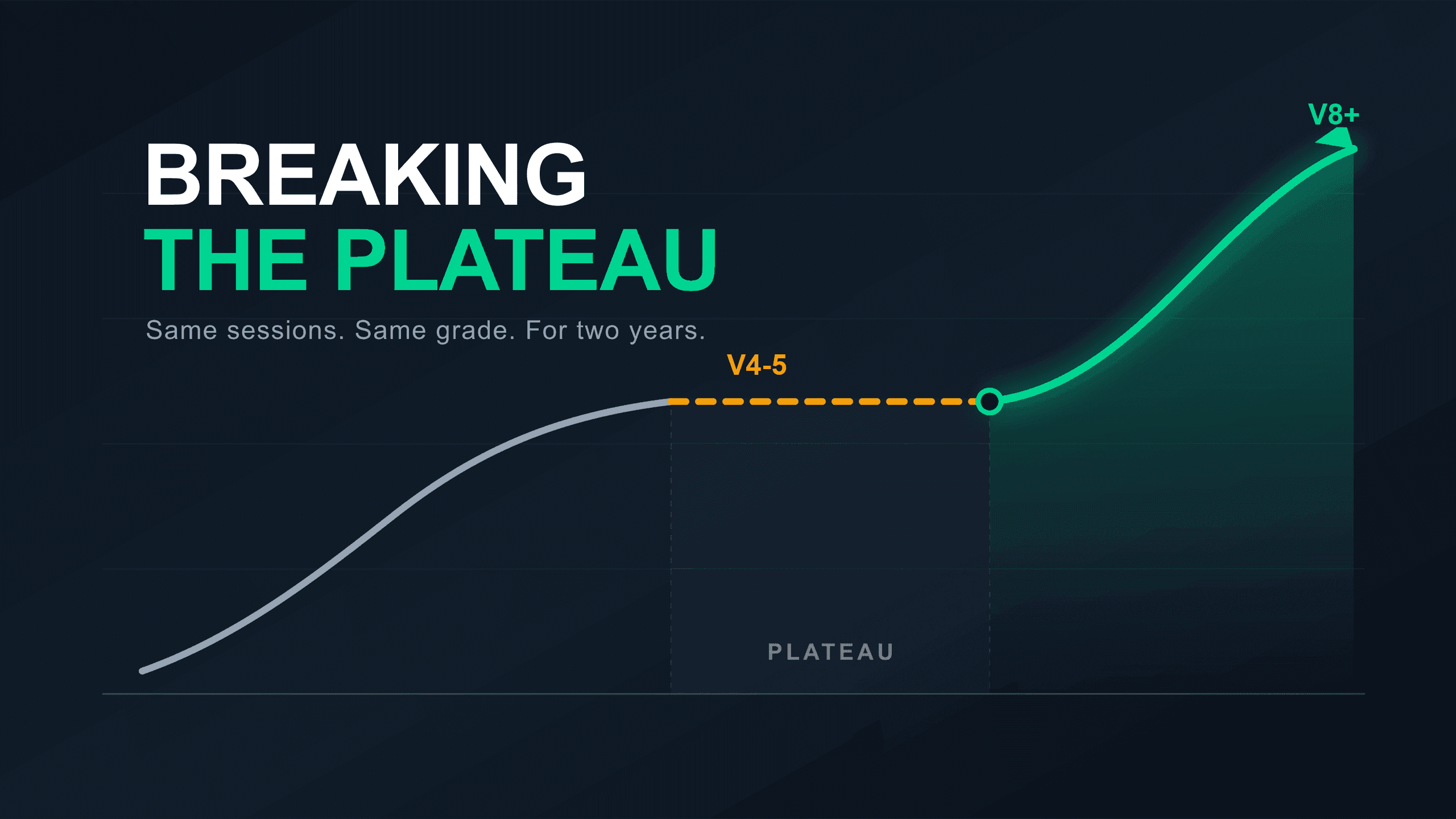
As long as the stimulus is new, you grow. When adaptation to that stimulus is finished, simply continuing to do the same thing becomes pointless. A plateau does not always mean you are not trying hard enough - very often it means the body has already adapted to that specific type of load.
The load stays, the growth stops, and the injury risk quietly remains. Keep the goal, change the dial: duration, intensity, volume, sets and rest, or the format itself.
Climbers keep doing the same hangs out of inertia, even when the format has stopped producing gains. The mistake is not that the exercise is useless - it is that it has finished its job.
The rule
A plateau is rarely a discipline problem. Change one dial - duration, intensity, volume, rest, or the format - and growth restarts.
Principle 10 · individualization
Your plan is not their plan
Picture each level as a door you have to open, and every door needs its own key. One key does not open all of them. And your key is not the same as the next climber's key.
Two climbers at the same grade can need opposite plans: different history, schedule, recovery, weak systems. That is why most plans fail not because the work is wrong, but because the work is aimed at the wrong thing.
Climber AV5 · plateau
Limiter: finger strength.
The plan: strength first, technique maintained.
Climber BV5 · plateau
Limiter: movement quality.
The plan: technique first, strength maintained.
Same grade, opposite plans. Fixed formulas like "40% technique, 30% strength" have no scientific basis. A plan starts from your limiter, your schedule, your history.
The rule
Before copying anyone's program, ask one question: is their limiter yours? If you cannot answer, you are training someone else's weakness.
Want a plan aimed at your limiter, not someone else's?
Take the quizPrinciple 11 · the five systems
Train your weakest link
Before you ask "what should I train?", ask "what is currently stopping me?" A plan built without that answer is just generic effort.
Climbing performance stands on five systems: how you move, how you are built physically, how you decide and hold focus, how you recover, and how specifically you prepare for what you climb. A plateau usually means one of them is the main limiter - and while it stays untouched, the grade will not move.
Your grade is set by your worst style, not your best one. Two years at a grade is not a talent problem. It is a diagnosis problem, and then a plan problem.
The rule
Most plateaus are not solved by adding more max-effort work. They are solved by removing a specific limiter. Be honest about which one is actually yours.
Principle 12 · motor learning
The brain does not care what it memorizes
For the brain there is no right or wrong movement. It memorizes the pattern you feed it. Repeat an inefficient movement enough times, and the brain files it as the correct one - and brings it back every time the move gets hard.
That is why technique needs its own sessions, not the leftovers of a strength day. And on those days, change the goal: the task is not to send the route, it is to climb it well.
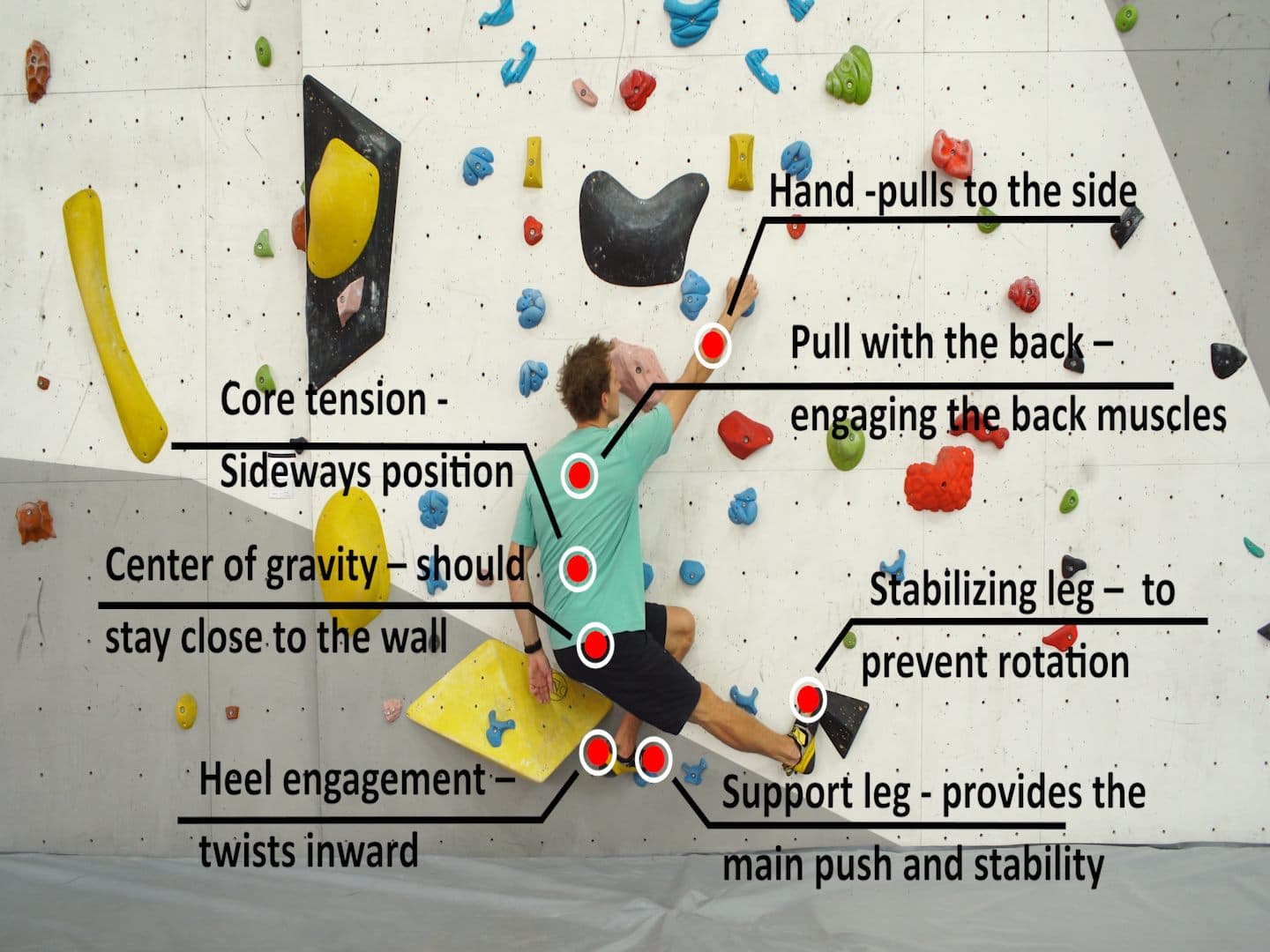
Technique has a cruel property: it is invisible from the inside. You feel like you set the foot precisely. From the ground it was a slide and a re-adjust.
The rule
Film two attempts on your project. Not for social media. Watch the feet. Most climbers find their answer in the first thirty seconds, and it is not about their hands.
Principle 13 · mental training
Fear is trained like strength
Fear is natural. It is how the brain protects us from uncertainty and danger - it has been wired for survival since ancient times. Fear is not an enemy. The problem starts when it becomes excessive: it paralyzes action, makes you avoid challenges, and progress stalls.
So you work with it the way you work with strength: not by running from it, but by analyzing it, understanding where it grows from, and training it step by step. There is no magic pill - and you do not need one.
Muscles adapt to load in a few weeks. Tendons take months. But the mind has no single timeline. Sometimes it changes in a moment - one fall, one conversation with yourself. And sometimes it takes years.
The rule
Fear is not something to eliminate - it is something to understand and train, just like strength or technique.
Principle 14 · autoregulation
Listen to the load
A plan is a hypothesis about how your body will respond. Life keeps interfering with that hypothesis: sleep, work, stress, bad nights. So you manage the actual load by state - and the main signal in climbing is fingers and connective tissue. Muscles recover in days, tendons and ligaments in weeks. The route will wait. A pulley you tear will not.
- Sleep quality is dropping during a training week
- Performance falls even though effort is the same or higher
- Fingers, elbows, or shoulders feel sore or stiff into the next session
- Motivation collapses despite progress on paper
- You are climbing through pain that does not settle on rest days
The rule
Any one of these is a signal to lower volume or intensity for the next few sessions. Two or more at the same time is a deload, not a discussion.
A drop in motivation often comes before the rest. Why that happens, I wrote about in how motivation affects your climbing.
Principle 15 · environment
You become what surrounds you
There is a saying I grew up with: drop a fresh cucumber into a jar of brine, and it has no choice - it becomes a pickle. The English-speaking world puts it differently: you are the average of the five people you spend the most time with. Same mechanism.
Environment is the people you climb with, talk training with, follow - even on social media. They quietly calibrate your normal: what counts as hard, what counts as training, what counts as discipline. And a plan is environment too - having one is a way to surround yourself with forward motion.
Change the jar, and the same effort reads differently. Six months around people who train with intention does more than any single heroic session.
The rule
Choose the jar. Climb with people slightly stronger than you, follow people who train with intention, and keep a plan that points the week forward. The environment does part of the work for you.
Principles tell you what matters. A program tells you what to do.
Each of these principles goes deeper than one page. Finger strength alone has phases, protocols, and readiness gates. Technique could fill a book of its own. This guide shows you the system - it does not replace the work of applying it to your level, your schedule, your history.
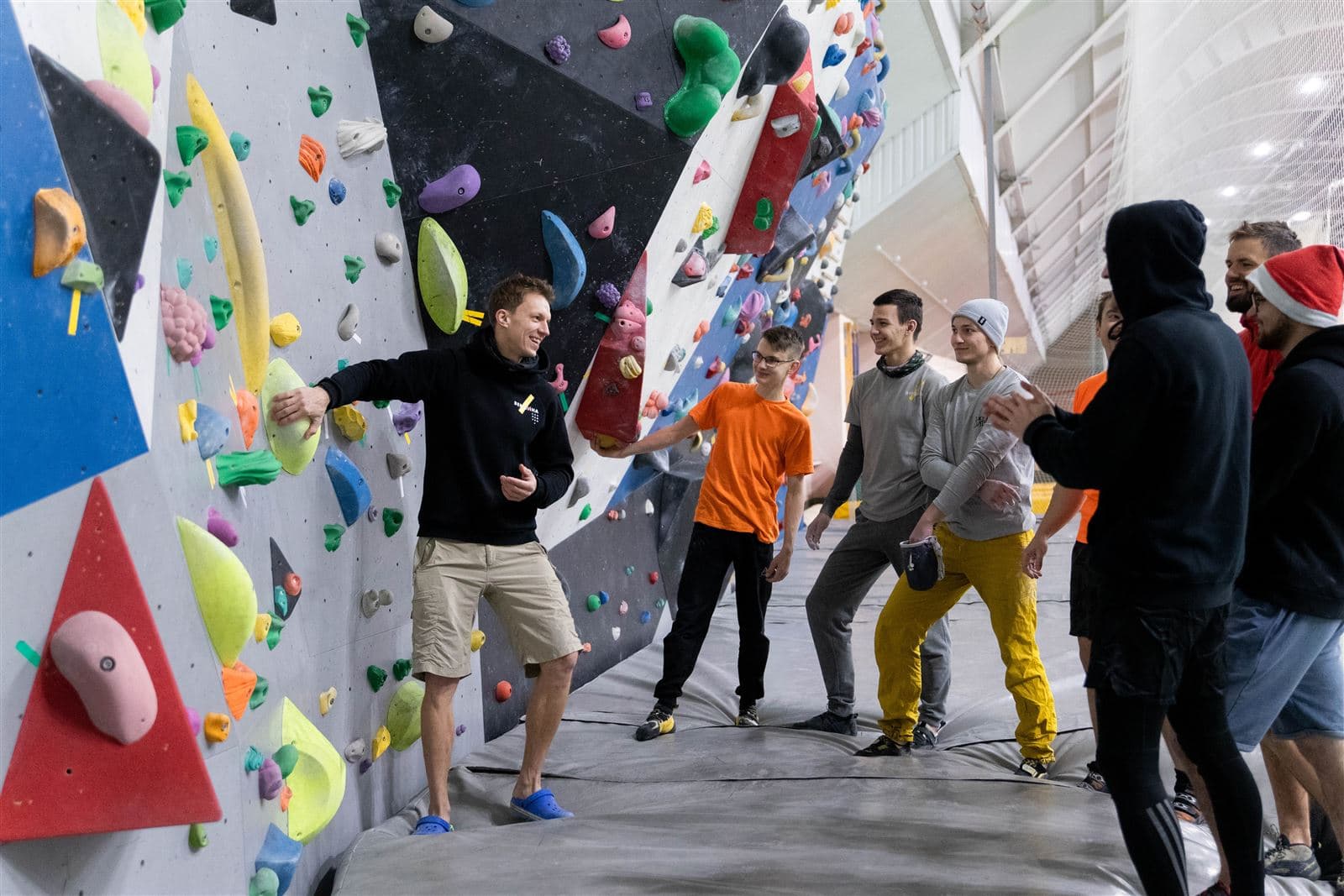
The EternaClimb quiz finds where you're weakest right now. The program builds it back, one focus at a time: a structured plan built around your level, goals, schedule and gear - reviewed and adjusted by a coach - and built on the same fifteen principles you just read.
Which principle is your training missing?
Get Your Personalized Training Plan