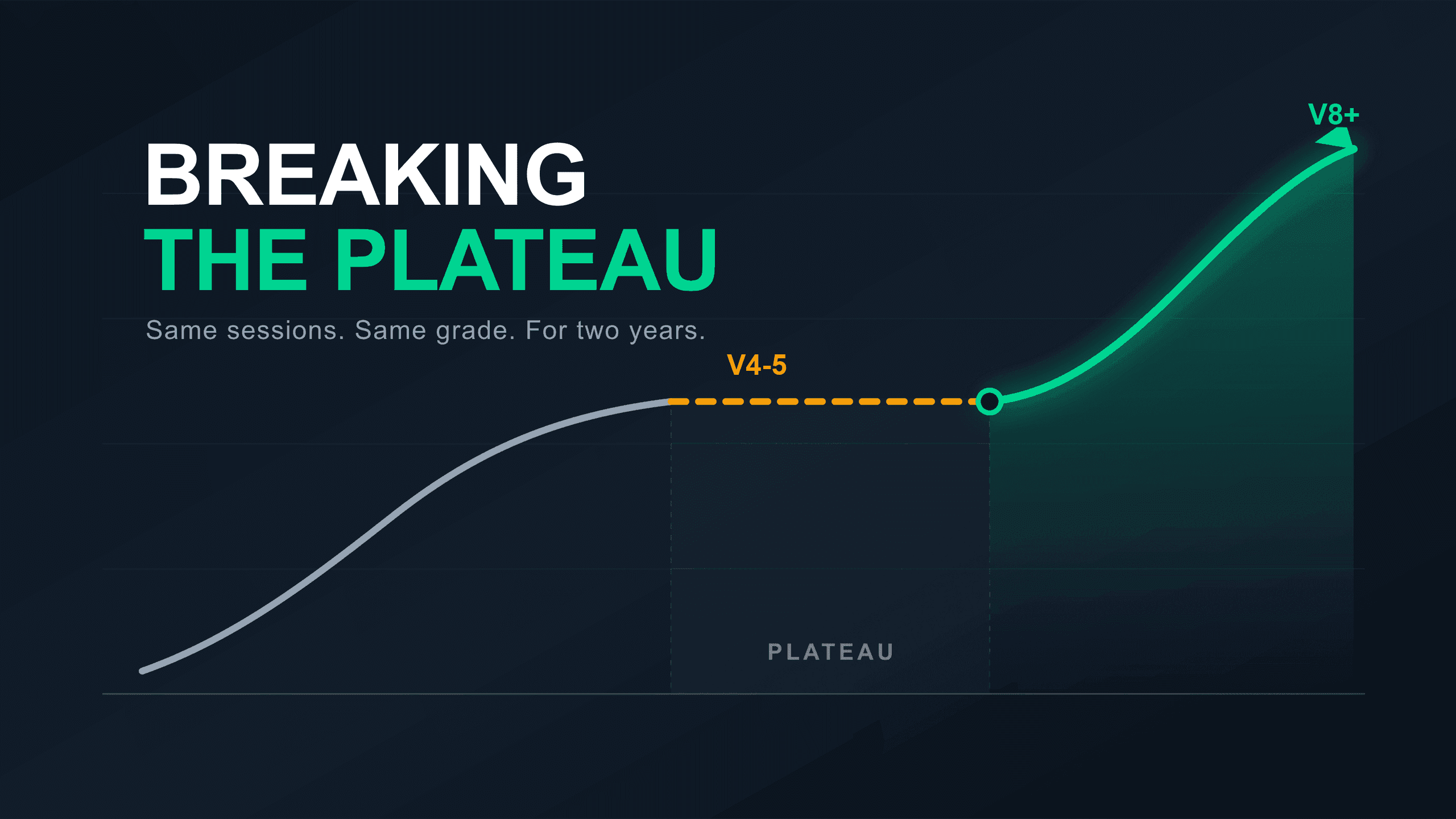
Almost every week I hear the same sentence. Someone comes off a route, shakes their arms out, and says it: I'm just not strong enough.
Then we start checking whether that is true. Usually it is not.
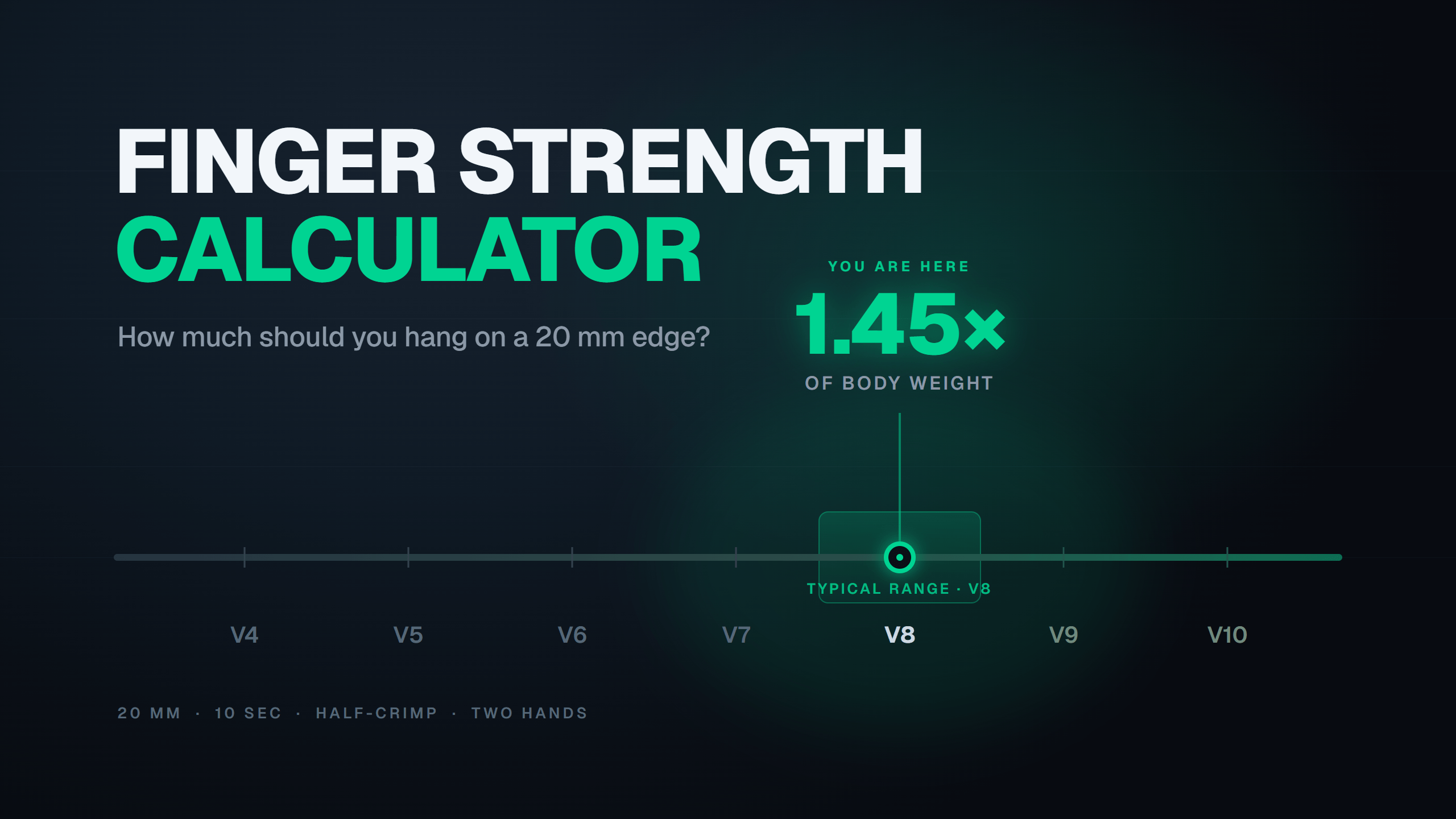
The thinking behind that sentence is fair. Climbing looks like hanging off small holds with your hands, so you need stronger fingers. And then comes the question I get asked most often: what do I do to get them?
That question sends people into months of hangboard work. Sometimes that is the right answer. Often it is not, or not yet, because it skips a step. Before you spend twelve weeks on it, it is worth knowing where the force that keeps you on a hold actually comes from, and how much of it you decide today.
Two things change when you know that. You stop paying months for something you may already have. And you start climbing routes this week that felt out of reach because of strength. I see it in sessions constantly. We brush the holds, we turn the hips a few degrees, and the move that was impossible becomes more than doable.
Four things decide whether you stay on a hold. Three of them you can change today, between two attempts. One of them you cannot, and it is the one everybody blames first.
Lever one: friction between your skin and the hold
It does not matter how much power the car has. On a wet or icy road you spin the wheels and slide. On dry asphalt with the right tyres, the same engine puts everything it has onto the ground.
Your fingers are the engine. The contact between your skin and the hold is the road. And unlike the engine, the road you can change in a minute.
- Brush the hold. On a project you have already tried ten times, the hold is dirtier than when you started. Chalk builds into a layer, and that layer works like dust.
- Chalk: more is not better. This is where climbers get it backwards. Chalk over chalk over chalk and the hold goes greasy, your hand slides on it, and you compensate the only way you know: you squeeze harder. Now you are spending finger strength on a problem that was never about strength. Dry your hands, chalk lightly, blow the rest off.
- Temperature. Friction works best in a fairly narrow band, roughly 10 to 18 degrees, and best of all around 15. Warmer than that and your hands sweat, and sweat destroys friction. Colder and your fingers lose sensitivity. What you want is hands slightly cooler than the air around them.
None of this makes you stronger. All of it makes more of your strength arrive at the hold.
Lever two: the angle you load the hold at
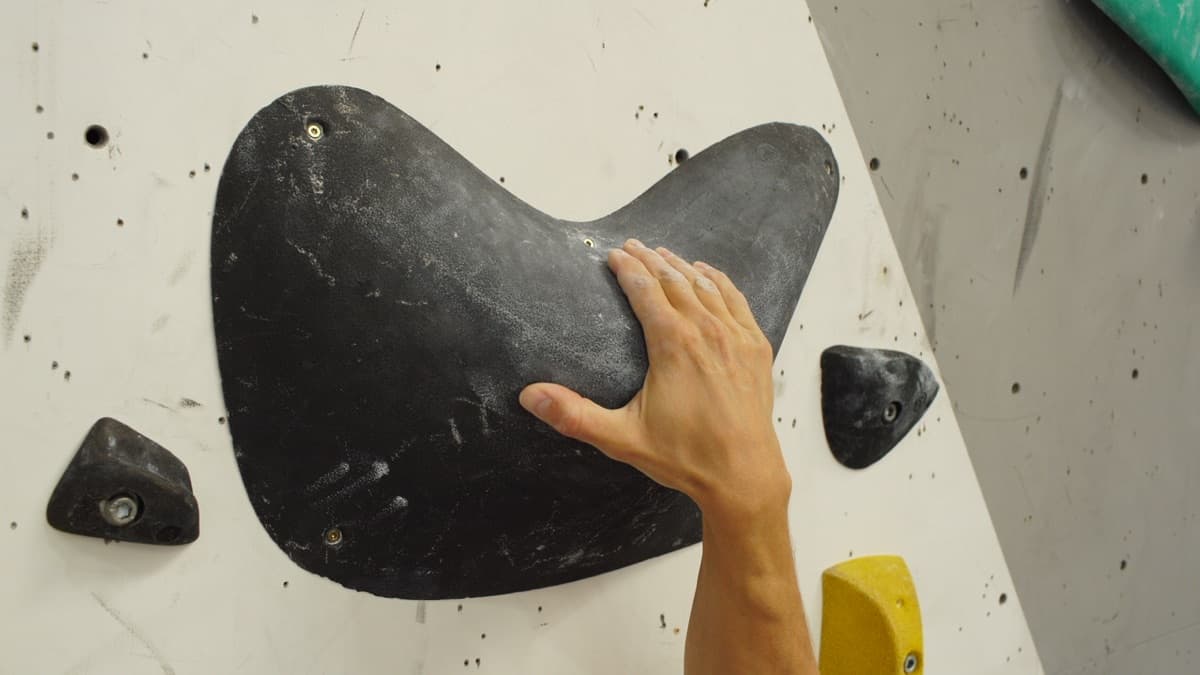
Every hold has a working plane. One direction it was shaped to be loaded in, where it gives you all of its friction, and a whole set of directions where the same piece of plastic gives you almost nothing. An incut edge pulled straight down is close to a jug. The same edge pulled out and sideways is not a hold at all, and no amount of finger strength saves it.
So on a move you keep losing, the question is not whether you can hold this. It is whether you are loading it where it works.
And you almost never change that direction with your hand. You change it with your feet. Move a foot out wide and the pull on your right hand rotates. Step higher and it rotates again. The hold did not change. Your direction did.
Lever three: where your body is
Gravity is your friend and your enemy at the same time. Body position decides which one you get.
Your weight is going somewhere no matter what you do. Hips away from the wall on steep ground, and that weight peels your fingers off the hold, pulling in the exact direction the hold cannot resist. Hips in, feet loaded, and the same weight presses you into the wall instead.
You did not generate anything new. You redirected what was already there.
This is why two climbers with the same fingers perform differently on the same move. Gravity is not behaving differently for one of them. What changes is how much of that weight reaches the fingers, and which direction it pulls them in.
Those are two separate things, and it helps to keep them apart. Loading your feet moves a share of your weight off your hands, so the fingers carry less. Opposition works differently. Press against a sidepull with an opposing foot and the load on that hand does not drop, it usually goes up. What you buy is direction: the resulting force now points into the working plane of the hold, where the hold can resist it, instead of off the side where it cannot.
The one thing you cannot change today
The actual force your fingers can produce. Tendon, pulley, muscle, and the neural drive behind them. That is months of work, and no chalk bag, foot placement or hip position moves that ceiling by a single kilo.
Which is why blaming it first is such an expensive habit. You point at the one thing you cannot touch and walk past three you can.
Rest counts too, and almost nobody counts it
A maximal effort is short. The hard part of an attempt lasts a few seconds, and it is over before your body gives you any of the signals you read as tired. No pump, no burn, no heavy breathing. So you feel fine, and you pull on again.
The feeling is misleading. Efforts like that run on phosphocreatine, the system behind everything short and maximal. It empties in seconds and refills over minutes, and none of that announces itself. You feel recovered long before you are.
So you go again on a system that is still half empty. The next attempt comes out weaker, and after two or three of those you are not training strength anymore, you are just getting tired. Rest three to five minutes between real attempts, roughly a minute for every hard move on the problem. It feels like far too long. That is the difference between training at your ceiling and training just below it.
Before you blame your fingers: the isolated check
Here is how you find out for real, and it takes about ninety seconds.
Go back to the hold you came off. Brush it. Dry your hands and chalk properly. Get into the body position the move actually needs, feet where they belong, hips where they belong. Now just hold it. Not the move. The hold.
- You can hold it. Then your fingers were never the problem. You lost the move somewhere in the three levers, and now you know which one to hunt.
- You cannot hold it even like this. Then you are getting close to a real strength answer. Close, not there yet.
Because before you sign off on that verdict, work through the variations. There is almost always more than one way into a hold and more than one body position that solves a move. Different grip, different foot, hip higher, hand turned, the whole sequence read the other way round. Try the versions that look wrong. That is not wasted time, that is the work.
And ask. If someone in your gym has done the move, get them to show you how they hold that exact hold. Ten seconds of watching a person who can do it teaches you more than six more sessions of guessing on your own.
Once you have done all of that and it still does not go, then it is fair to say the limit is strength.
How it all adds up
Everything above comes together in one line, the force that actually keeps you on the hold:
Three terms out of four are green. That is the whole article in one line: you spent the session arguing with the one term you cannot move, while three of them sat there waiting. If you want the physics properly, I broke the formula down term by term in Short-Term and Long-Term Factors Affecting Grip Strength.
The check to run in the gym
Next time a hold throws you off, in this order:
- Isolated check first. Clean hold, dry chalked hands, correct position. Can you hold it at all? Answer that before you conclude anything.
- Friction. Is the hold brushed? Are my hands dry, or just chalked over sweat? Am I caking chalk on and squeezing harder to make up for it?
- Angle. Am I loading this hold in its working direction? What happens if I move a foot?
- Body. Are my hips in? Are my feet taking weight? Is gravity pressing me in or peeling me off?
- Rest. Has it really been three to five minutes, or does it only feel that way because the attempt was short?
- Variations. Have I tried the other ways of doing this, and have I asked someone who can do it?
Run that and you will have sessions where you climb better than you did an hour earlier, with the exact same fingers.
And underneath all of it, your physical base
There is one more factor people forget, and it is no smaller than the rest.
Finger strength is one thing. The angle you load a hold at is another. Underneath both sits a plainer question: can you use the strength you already have? Can you hold your body where the move needs it, create tension through your torso, and keep it there while your hand does its job?
If you cannot, the third lever barely exists for you, because there is nothing to press with. Body tension is what connects your hand to your feet.
This is the base that lets you climb at the level you climb at. It is not something you finish. Every next grade asks for a bigger version of it, and building that is a large part of what a program is for.
Want the long-term half of this built around your climbing?
Get Your Personalized Training Plan